Investment Accelerates Shift From Long-Haul Trucking to Integrated Freight Rail
_1.jpeg)
By Liesl Venter
Rail expansion across the GCC is picking up speed, unlocking new transport options for breakbulk movers. Major operators, including the Red Sea Gateway Terminal, weigh in on what comes next.
From Issue 1, 2026 of Breakbulk Magazine
(6-minute read)
Rail has long carried a sense of nostalgia, perhaps more so in the Gulf, where the desert lies in silence while new towns, ports and industrial zones rise around it. In this setting, the return of rail feels both familiar and new. Saudi Arabia and the UAE are leading the charge, expanding freight rail beyond bulk minerals and into a wider logistics role.
“This is the golden age of rail in the GCC (Gulf Cooperation Council),” says Edward James, head of content and research at MEED. “Over the last 10 years there’s been a realization that expanding rail capacity, for both passengers and freight, is an important economic driver for each country.”
.jpg) There are significant large-scale investments with long-term strategic intent, aimed at building economic competitiveness and strengthening regional connectivity. “The long-term objective for Saudi Arabia, for example, is to increase the contribution of the entire transport and logistics sector to 10% of nonoil GDP by 2030, a key metric for its Vision 2030,” said Juwairiya Fatima, consulting analyst, supply chain and logistics practice at Frost & Sullivan.
There are significant large-scale investments with long-term strategic intent, aimed at building economic competitiveness and strengthening regional connectivity. “The long-term objective for Saudi Arabia, for example, is to increase the contribution of the entire transport and logistics sector to 10% of nonoil GDP by 2030, a key metric for its Vision 2030,” said Juwairiya Fatima, consulting analyst, supply chain and logistics practice at Frost & Sullivan.
Projects such as the US$7 billion Saudi Land Bridge, a major new railway line linking Jeddah Port with Riyadh, are more than infrastructure schemes; they are economic enablers designed to unlock new industrial zones and improve supply chain resilience. “The sheer volume of investment signals a calculated effort to secure a greater and more predictable share of global freight movement by offering a reliable land bridge alternative to sea routes, especially for traffic moving between Asia and Europe,” said Fatima. “This financial commitment underscores the nation’s resolve to diversify its economy and cement its role as a pivotal logistics hub.”
What began as separate national projects are now evolving into integrated corridors that connect ports, free zones and borders, creating a rail system with genuine potential to move oversized equipment, energy-transition components and megaproject cargo at scale.
“The most obvious example is the Etihad Rail project in the UAE,” said James. “It was originally built to transport sulfur from an oilfield in Abu Dhabi to the coast, but has since been expanded and now links the Saudi border with Abu Dhabi, Dubai, Sharjah and Fujairah. A lot of that is about taking cargo off the roads and linking the UAE’s major ports, Fujairah, Jebel Ali and Khalifa, and creating a more reliable way for freight to move both coast-to-coast and cross-country.”
“The long-term intention is for these freight lines to connect with neighboring countries and move goods across the region,” he said. “This is now happening for the first time through the Hafeet Rail project, which will link the Etihad Rail freight network through Al Ain and into northern Oman, terminating at Sohar Port. It will be the first inter-country freight railway in the region.”
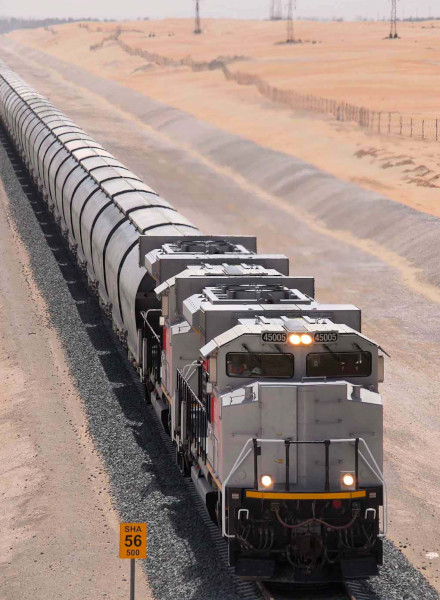
Etihad Rail has already proven its utility as a bulk-haul system and a port connector, with freight now moving on scheduled services across the country. The network was built in stages, with a first stage carried out simultaneously with the construction of the Shah gas plant and a ship-loading facility at Ruwais.
More than 4,000 workers and 30 subcontractors took less than three years to complete the 264-km line. The excavation of more than 90 million cubic meters of earth and the installation of civil works, tracks and systems were carried out by lead contractor Saipem alongside partners Tecnimont and UAE-based Dodsal.
“The railway from Shah, Habshan and Ruwais carries granulated sulfur for export, making the UAE the world’s largest exporter of this commodity after the line opened,” said Kevin Smith, editor-in-chief at the International Railway Journal. “While exact traffic volumes are not publicly disclosed, the wider 1,200-km network from the Saudi border to Fujairah is operational, and multiple commercial agreements are already in place.”
Meanwhile, construction of Hafeet Rail, a joint venture between Etihad Rail, Mubadala Investment Company and Oman’s Asyad Group, is more than 50% complete, with the 238-km cross-border line making “fast development progress,” Etihad Rail CEO Shadi Malak was quoted as saying by local sources. Among the project’s contractors, Siemens Mobility was picked to work alongside Egypt’s Hassan Allam Construction (HAC) to deliver the design, build and integration of the network’s ETCS Level 2 signaling, telecom and power supply systems.
Rail investments across the region are not short-term experiments. They are capital-intensive, long-horizon programs backed by national industrial policy.
Building a Regional Network
 According to Moayad Musalli, commercial director for Red Sea Gateway Terminal’s (RSGT) multipurpose business in Saudi Arabia, the current investments are measured in the billions and are strategic, rather than tactical.
“These networks are designed as long-term national assets that will reshape freight flows, diversify economic activity and unlock new inland industrial zones. They support national logistics strategies and are central to energy transition and industrial diversification agendas,” he said.
“Construction of a wider GCC freight network that will eventually connect all six states is significant,” said Smith. “Different sections are at different stages of development. The UAE has completed its link to Saudi Arabia and is working with Oman on a cross-border freight line from Abu Dhabi to Sohar. Kuwait and Qatar recently confirmed plans to develop their respective sections. Bahrain is targeting a second causeway to Saudi Arabia that will carry a rail link. Saudi Arabia has promised to complete connections to the UAE border, but it is unclear whether these projects are proceeding.”
While activity across the GCC is significant and several sections are advancing, industry observers caution that a fully harmonized 2,117-km regional network remains a long-term ambition rather than an imminent milestone. “There is no central organization set up for this GCC railway,” said James. “The GCC secretariat has tried to influence things and push progress along, but there is no dedicated body overseeing development, harmonization or regulatory alignment.”
Little Harmonization
With no supranational rail authority, each country is responsible for building its own section and then connecting at the borders. Over time, the GCC freight network will require harmonized customs procedures, immigration controls, safety standards and operational protocols to ensure seamless cross-border movement.
“I wouldn’t say there is harmonization necessarily,” said James. “To illustrate this, Etihad Rail is now considering building a causeway from the far west of Abu Dhabi to offshore islands and then a ferry network to Qatar, bypassing Saudi Arabia completely. That shows the extent of the challenges in building a full GCC railway network.”
Rail development across the region also shows different levels of maturity. The UAE and Saudi Arabia are furthest ahead, with operational freight networks and active passenger expansion. Other states are in the nascent stages of their programs.
“Qatar, Bahrain and Kuwait do not have operational railways and until recently Oman did not either,” said James. “The UAE only built its first railway in the last 15 years. Saudi Arabia has expanded beyond its original Dammam–Riyadh route, but its newer lines, such as mineral and fertilizer corridors, are still relatively recent.”
These differences do not indicate lack of commitment but rather reflect the varied size, geography and industrial priorities of each state. “Institutional integration and an uneven project velocity across GCC member states, does create scheduling risks for the unified 2030 network deadline,” said Fatima.
Cross-border rail freight also demands a more nuanced regulatory framework than standardized container flows. “Breakbulk and over-dimensional cargo require specialized handling, escorts, route surveys and bespoke permitting, which must be aligned to prevent stop-start delays at border crossings. While the GCC operates under a Common Customs Law, the practical application of the 12-digit Integrated Customs Tariff to complex rail consignments will need gradual harmonization to support predictable long-haul scheduling,” said Fatima.
_1.jpeg) Despite the complexity of multi-country regulation, stakeholders stress that coordination is progressing in phases rather than all at once. Bilateral agreements, shared infrastructure planning and gradual standards alignment are becoming more visible as freight volumes grow and commercial incentives strengthen.
Despite the complexity of multi-country regulation, stakeholders stress that coordination is progressing in phases rather than all at once. Bilateral agreements, shared infrastructure planning and gradual standards alignment are becoming more visible as freight volumes grow and commercial incentives strengthen.
“Bilateral cooperation between neighboring states, such as the UAE and Oman, is gaining momentum, and structured GCC-level committees are now emerging to guide long-haul freight connectivity,” said Musalli. “Public–private partnership models and private-sector-led corridor development are also gaining traction, particularly where large industrial flows guarantee demand.”
As regional rail corridors mature, project-cargo capability will evolve in structured phases, driven in no small part by private-sector capital and operational expertise.
“The current focus remains on developing the Land Bridge, with container and passenger volumes taking initial priority,” explained Musalli. “Non-containerized rail development is largely advancing through private sector investment on corridor-specific legs. The first phase involves constructing heavy-lift capable terminals and rail sidings and reinforcing pavements and storage for oversize units.
“This will be followed by expanding roll-on, roll-off (RoRo)-compatible rail sidings and open yards, integrating rail scheduling into port community systems, and developing dedicated project cargo services with guaranteed capacity.”
According to Fatima, the single most transformative development that will redefine freight dynamics across the Middle East is the full commissioning of the Saudi Land Bridge. “This is no mere expansion of a rail network; it is the strategic reengineering of the global trade route across the Arabian Peninsula. It will make Saudi Arabia a true continental logistics hub by offering a dedicated, high-capacity, east-west freight corridor that crosses the kingdom,” she said.
The Land Bridge will connect Red Sea ports such as Jeddah and King Abdullah Port to Arabian Gulf gateways and Riyadh, establishing a land-based alternative to the costly and geopolitically complex maritime detours around the Strait of Hormuz and wider Peninsula.
“It enhances transshipment competitiveness with far faster and more predictable passage times, potentially shifting transit windows from days to hours,” Fatima continued. “This makes it a highly competitive alternative to long ocean hauls for Asia–Europe cargo. The shift is crucial for securing a predictable share of global freight movement.”
Looking Ahead
Amid intensifying geopolitical pressures, rail has re-emerged as a strategic freight asset across the region. But Fatima highlights one trend that is far less visible yet enormously consequential for heavy and project cargo: the rapid rollout of rail-linked logistics parks and dry ports.
These facilities are designed to resolve one of the sector’s structural bottlenecks: the complex and expensive last-mile movement of large, non-standard cargo. The Saudi Ports Authority (MAWANI) is currently supervising the development of 11 integrated logistics zones, including a US$347 million logistics park at King Abdulaziz Port in Dammam.
As these logistics parks and rail-linked inland zones move from construction toward operational maturity, private-sector participation becomes central to their success. According to Musalli, PPP models bring operational agility, customer-focused service design and flexible capital deployment, ensuring predictable throughput and faster network readiness.
Fatima adds that the technical conditioning achieved through heavy-haul mineral movements already provides a scalable engineering foundation for oversized modules, significantly reducing operational risk. “Once major EPC companies are aware of the full range of economic predictability, superior scale and reduced environmental impact that rail offers compared to long-haul road transport, the share will irrevocably shift,” said Fatima.
For the GCC’s heavy industry, that shift signals rail’s emergence as a core mode for project cargo rather than a peripheral alternative.
Interested in joining the conversation? A panel of industry experts will be discussing the latest rail developments in the GCC in a main stage panel session at Breakbulk Middle East 2026. The GCC Rail Network Revolution will take place on Thursday, Feb. 5 from 10:30am-11:15am.
Top photo: Etihad Rail Stage 1. Credit: Saipem
Second: Juwairiya Fatima. Credit: Frost and Sullivan
Third: Etihad Rail Stage 1. Credit: Saipem
Fourth: Moayad Musalli. Credit: RSGT





.png?ext=.png)







.png?ext=.png)









_1.jpg?ext=.jpg)