Jumbo Offshore and CoreMarine Prepare for Complex FLNG Installation Campaign
By Malcolm Ramsay
From Issue 3, 2026 of Breakbulk Magazine
(5-minute read)
Demand for liquefied natural gas (LNG) has grown rapidly in recent years. Following the outbreak of war in Ukraine and the disruption to shipping through the Strait of Hormuz, pressure is mounting on buyers to find new sources of this vital fuel.
With significant gas supplies constrained by sanctions or else at risk of transit issues, the economics of developing complex shale gas resources have shifted markedly, bringing renewed focus to new field development. However, the necessary infrastructure remains complex and requires deep breakbulk know-how.
Among the most promising unconventional gas developments is Argentina’s Vaca Muerta, a vast shale formation in the Neuquén Basin that holds some of the world’s largest unconventional gas resources.
Seeking to monetize these reserves, Argentine energy company Southern Energy S.A. (SESA) is developing a phased offshore LNG export project in the Gulf of San Matías, off the coast of Río Negro province. As part of the project, SESA and its partners recently awarded Jumbo Offshore and CoreMarine a contract for the transport and installation of a specialized Soft Swivel Yoke (SSY) mooring system and the hook-up of two floating LNG (FLNG) vessels.
“Golfo San Matias is very remote, which means you need to be prepared to cope with contingencies, and even more importantly, perform very detailed project preparations to prevent surprises on site,” Brian Boutkan, commercial director of Jumbo Offshore, told Breakbulk, adding that the award “reflects the strength of the collaboration between our two organizations.”
Located around 30 kilometers off the Río Negro coast, SESA’s phased LNG project in the Gulf of San Matías requires specialized heavy-lift and marine installation capabilities to deploy FLNG vessels. The Gulf’s exposed Atlantic conditions and limited port infrastructure for a project of this scale also demand meticulous planning, with contingencies for weather-related delays and the timely delivery of modular components to the remote offshore site.
Offshore Construction Complexity
.jpeg) At the center of this first phase of operation are two FLNG vessels, the Hilli Episeyo and MKII. These giant liquefaction facilities are set to be moored in the remote Gulf of San Matías using the SSY mooring system, the first time this has been deployed in Argentine waters.
At the center of this first phase of operation are two FLNG vessels, the Hilli Episeyo and MKII. These giant liquefaction facilities are set to be moored in the remote Gulf of San Matías using the SSY mooring system, the first time this has been deployed in Argentine waters.
The robust SSY system is designed to securely anchor the Hilli Episeyo and MKII FLNGs to a central underwater turret, which allows them to rotate freely with wind, waves and currents, maximizing stability and operational efficiency. The Hilli Episeyo is scheduled for installation in 2027, followed by the MKII in 2028.
“Projects like this are at the top end of offshore construction complexity,” said Ben Fitzgerald, CEO of CoreMarine. “Moving, positioning and permanently installing floating assets of this scale demands absolute precision, proven experience and flawless execution offshore. This is where CoreMarine and Jumbo Offshore will make a real difference.”
Headquartered in Stavanger, Norway, CoreMarine is a global offshore engineering and subsea services provider, specializing in complex installation, hook-up and diving operations. For the Gulf of San Matías project, the company will lead the subsea and construction scope, including spool installation, riser hookup, saturation diving, ballasting and pre-commissioning of the FLNG vessels.
Rising to the Challenge
The scale of the operation becomes clear when considering the sheer size and weight of the components involved. The SSY mooring system will be supplied by Texas-based equipment firm NOV and features a colossal steel structure weighing more than 1,200 tonnes and measuring nearly 40 meters long and 15 meters high.
The SSY is designed to connect to each FLNG via two mooring legs, allowing the vessels to weathervane through 360 degrees in response to wind, waves and current. This is no mean feat as the MKII, the larger of the two vessels, measures 390 meters long and 70 meters wide. It will provide an expected production capacity of 3.5 million tonnes per annum (mtpa) of LNG, alongside 2.45 mtpa from the Hilli Episeyo. The full mooring system, including chains, anchors and risers, is expected to exceed 4,000 tonnes.
“The advanced production and loading SSY is designed to provide safe mooring and uninterrupted gas transfer via subsea pipeline,” said Haavard Hjellseth, managing director of APL, a subsidiary of NOV. “By removing the need for a jetty, the system aims to reduce topside infrastructure, lower project complexity, and enable SESA to deliver LNG to market more efficiently, addressing key customer challenges in offshore export developments.”
“We are delivering a robust, efficient, and tailored installation solution,” Boutkan said, adding that this “landmark development” will “support the delivery of critical energy infrastructure to the highest standards of safety and performance.”
Dynamic Positioning
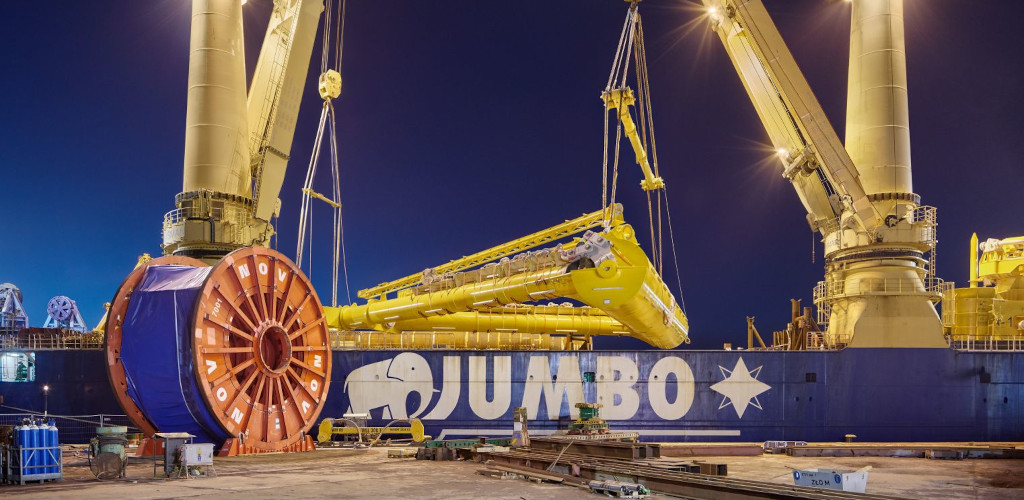
.jpeg) To ensure stability and precision during the transport and installation of these systems, Jumbo Offshore will utilize its DP2 HLCV vessel Fairplayer as a cornerstone of the Gulf of San Matías FLNG project. DP2 refers to its Dynamic Positioning Class 2 capability, meaning the vessel can maintain its position and heading using thrusters and GPS without anchors, critical for precision operations in deep water or challenging conditions.
To ensure stability and precision during the transport and installation of these systems, Jumbo Offshore will utilize its DP2 HLCV vessel Fairplayer as a cornerstone of the Gulf of San Matías FLNG project. DP2 refers to its Dynamic Positioning Class 2 capability, meaning the vessel can maintain its position and heading using thrusters and GPS without anchors, critical for precision operations in deep water or challenging conditions.
The Fairplayer is equipped with two 900-tonne cranes giving it a combined tandem heavy-lift capacity of 1,800 tonnes. Its large deck space of 3,200 square meters and high-load capacity make it ideal for transporting and installing massive offshore structures, such as the SSY mooring systems.
“One of the challenges is the shift of center of gravity and impact of wave and swell when going through the splash zone. The set-up of the Fairplayer is ideally suited to perform this lift with the two cranes on board,” Boutkan said, noting that the “dual crane lift of the yoke system already makes the lift more stable.”
With DP2 redundancy, the vessel ensures uninterrupted operations, a key safety feature for the remote and exposed waters of the Gulf of San Matías.
Phase 1 Underway
The first phase of transport is slated to start later this year, with Jumbo Offshore and CoreMarine “already in the project preparation phases”, according to Boutkan. This involves regular consultation with stakeholders and partners to ensure the timeline is met and will focus on preparing the installation of the Hilli Episeyo.
The dual-crane lift of the outsized yoke will be a critical early milestone, requiring positioning and real-time load monitoring to counter the Gulf’s currents and ensure the pieces align correctly. It will also be a valuable opportunity for local partners to gain firsthand experience of this type of complex installation.
“Our objective is not just to deliver two FLNG installations, but to leave behind strong local capability, confidence and a proven model for future offshore developments in the region,” Fitzgerald said. “SESA has put a great deal of trust in us and our abilities. We look forward to working even closer with them to deliver these landmark projects.”
Once the SSY systems are anchored, CoreMarine will lead the subsea hook-up phase, including spool installation, riser connections and saturation diving to secure the FLNGs to the mooring turrets. The simultaneous operations will involve multiple vessels, including deep-submergence vehicles (DSVs) for diving, tugs for station-keeping, and support boats, all coordinated to avoid conflicts in the confined offshore workspace.
Rodolfo Freyre, chairman of SESA, hailed the project as “a key milestone” for the future development of the Vaca Muerta gas resources. The energy firm is the lead partner in a consortium, comprising Pan American Energy, YPF, Pampa Energía, Harbour Energy and Golar LNG. The firm recently signed a landmark eight-year agreement to supply two mtpa of LNG to Germany’s SEFE, marking a critical step in positioning Argentina as a reliable global LNG exporter.
Read more: deugro's China-to-Argentina Logistics Challenge
Top photo: The Jumbo Fairplayer deploys its dual-crane system to handle the offshore structures. Credit: JSI Alliance
Second: Ben Fitzgerald, CoreMarine. Credit: CoreMarine
Third: Brian Boutkan, Jumbo Offshore. Credit: JSI Alliance






.png?ext=.png)










.png?ext=.png)









_1.jpg?ext=.jpg)