Offshore Wind Pipeline Shifts Focus From Ambition to Execution
By Luke King
While Europe’s offshore wind sector continues to face headwinds, the Baltic region is seeing a growing pipeline of projects move towards execution and construction. Companies including UTC Overseas and Istrana examine the market’s potential and the challenges that remain.
From Issue 4, 2026 of Breakbulk Magazine
(5-minute read)
Offshore wind has endured a difficult few years in Europe. Rising costs, supply chain pressures and problems with auction models have delayed projects and, in some markets, caused developers to reconsider investments. In the Baltic Sea, however, the direction of travel looks rather different, with Poland in particular moving from years of planning into construction and execution.
The region has an estimated offshore wind technical potential of more than 90 gigawatts (GW), with Poland emerging as the largest near-term market. After years in which much of that potential existed largely on paper, turbines are now turning, specialist port infrastructure is nearing completion and increasingly complex project cargo is actually moving through the supply chain.
Baltic Power, the 1.14-GW project being developed by ORLEN and Northland Power off Poland’s northern coast, began generating its first electricity this summer. The project comprises 76 Vestas V236 15.0-megawatt (MW) turbines and is one of the first commercial deployments of the manufacturer’s latest offshore platform. Behind it comes a growing pipeline, led by the 1.5-GW Baltica 2 project being developed by PGE and Ørsted, while Baltica 3, BC-Wind and further developments could extend construction activity well into the next decade.
“The feeling of ‘I will believe it only after I see it with my own eyes’ is now gone,” Jakub Walasek, director Poland at UTC Overseas, told Breakbulk. Walasek has good reason to say so. UTC was involved in logistics for Baltic Power, transporting four 345-ton transformers and four 135-ton shunt reactors to a greenfield site in an area whose infrastructure was never designed with cargo of that scale in mind.
“What was most significant was that the delivery location is a greenfield in a rural, tourist area and local roads were not prepared for that,” he said. “We needed to start from scratch and find the right solution.”
Bigger Cargo, Bigger Challenges
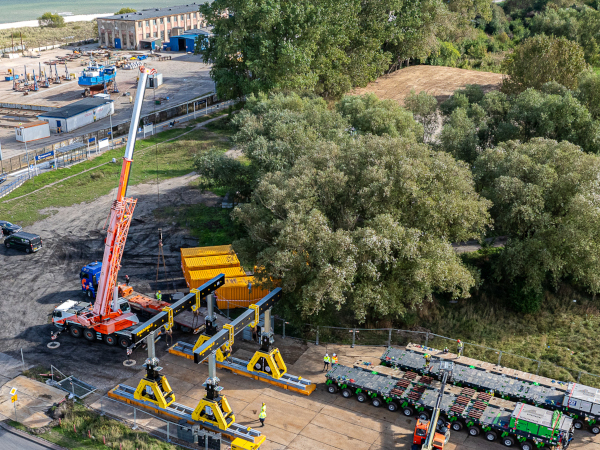 That experience illustrates one of the challenges facing Baltic offshore wind. Baltic Power’s onshore substation is located at Osieki Lęborskie, close to Poland’s Baltic coast, meaning UTC had to find a route for the transformers and reactors through an area where infrastructure was never designed for cargo of that scale. Walasek sees road access as potentially the biggest logistics challenge as more projects move into construction.
“This part of northern Poland was primarily a tourist area, and all the infrastructure was developed for that purpose,” he said. “There are fishing ports nearby to skip the road transport from the main port, Gdańsk or Gdynia, but still the bridges are class B or C.”
The answer increasingly involves multimodal logistics, with ocean shipping, barging and heavy road transport combined according to the limitations of individual sites. “The more demanding the final destination, the more multimodal the transport is,” Walasek said.
“We are in a race where engineers are preparing the best solution for a problem with certain rules, trying to find a suitable solution for the least amount of money. Someone wins, and then the rules change because there is another project with different rules. It’s like motorsport, that is basically a description of our business.”
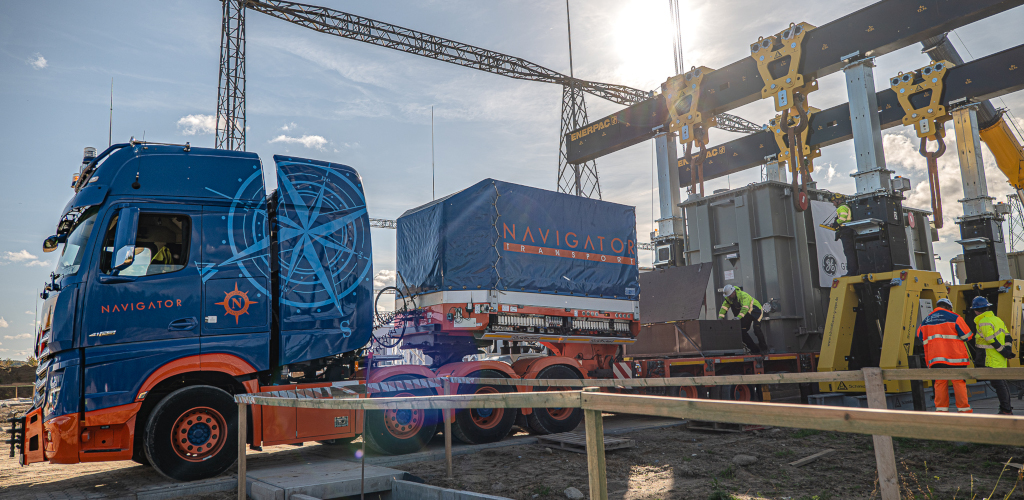
Recent work on Baltica 2 provides another example. COLI Group completed a six-month campaign for GE Vernova involving 14 large power transformers moved from Türkiye to Poland across three chartered voyages. Ten units weighing between 110 and 170 tons were discharged in Gdynia for onward road transport, while four 361-ton transformers followed a different route, moving by barge to Władysławowo before a complex RoRo operation.
The land transport required temporary flyover structures to be installed over existing bridges that could not support the cargo, while movements were coordinated with local authorities and continued through temperatures as low as minus 15C. “Moving 14 large and heavy units to the same site in three months in challenging conditions is not something any freight forwarder does every day,” Felix Peinemann, managing director of COLI Group, said.
Offshore execution is becoming equally specialized. JSI member SAL’s vessel MV Lone carried out the installation of all 76 transition pieces for Baltic Power, working with Van Oord and the wider project team. SAL’s scope went beyond transport and lifting, including the design and fabrication of dedicated installation and lifting tools and a custom sea-fastening grillage. The campaign was MV Lone’s first transition piece installation project.
Port Readiness
Major investment is also taking place ashore, including at the Port of Gdańsk, where a new installation terminal is being developed specifically for offshore wind. The structure behind the project involves several entities. The Port of Gdańsk Authority manages the wider port, while Baltic Hub Container Terminal operates the neighboring deepwater container terminal. Baltic Hub, together with the Polish Development Fund’s PFR FIZAN investment fund, is a shareholder in Istrana, the special-purpose company responsible for developing the new T5 Offshore Wind Terminal.
The 21-hectare heavy-duty facility is being constructed on reclaimed land alongside Baltic Hub and will initially support the construction of Baltica 2, giving the project a purpose-built base for the storage, pre-assembly and loading of offshore wind components.
Lech Paszkowski, CEO of Istrana, said the development demonstrates how far the market has moved. “For many years, offshore wind in the Baltic Sea was discussed primarily in terms of potential. Today, we are seeing tangible assets being built, investments being committed and infrastructure being delivered,” he told Breakbulk.
“Two years ago, the T5 project existed largely on paper. Today, the terminal is substantially completed, all key administrative decisions and permits have been secured, including the final occupancy permit, and we are in the final phase of finishing surface and infrastructure works ahead of handover to our first sub-lessee later this year.”
T5 has been designed specifically around the dimensions and weights of modern offshore wind equipment. Three dedicated quays will support different cargo flows, including an outbound quay capable of accommodating two jack-up installation vessels simultaneously, as well as separate facilities for LoLo and RoRo imports. Paszkowski said the terminal will be able to handle next-generation blades, towers and nacelles and, in the future, large monopiles.
But building enough port infrastructure is only part of the equation. Offshore wind manufacturers are confronting similar challenges as they increase production of ever-larger equipment, providing an indication of what can happen when a new supply chain is asked to scale rapidly.
Vestas began producing its V236-15.0 MW nacelles at Szczecin, Poland, in 2025. Baltic Power is among the first commercial projects using the turbine, which has 115.5-meter blades and a rotor diameter of 236 meters. In its 2025 annual report, Vestas was candid about the challenges of industrializing the platform, saying the learning curve across its factories had been “steeper than planned,” resulting in bottlenecks and delays despite mitigation efforts across its value chain.
The manufacturer said it had subsequently reduced production times significantly, but described the journey toward serial production and installation at Baltic Power and Germany’s He Dreiht project as “long and challenging.” The experience points to a wider issue for the Baltic: a large project pipeline promises work for manufacturers, ports, vessel operators and project forwarders, but delivering too much capacity simultaneously risks overwhelming the very supply chain being created to serve it.
Managing the Build-Out
 Paszkowski said Poland currently has only two locations with dedicated installation terminal capabilities for large offshore wind campaigns, Gdańsk and Świnoujście. Even large terminals cannot efficiently accommodate an unlimited number of projects simultaneously, given that offshore wind campaigns require extensive areas for storage, preassembly and vessel operations.
“If too many projects are scheduled within the same timeframe, capacity constraints can emerge, leading to higher logistics and installation costs and potentially forcing some activities to be relocated outside Poland or delayed,” he said. “Port infrastructure cannot simply be expanded overnight, so project schedules need to be aligned with the capacity that will realistically be available in the market.”
The objective, Paszkowski added, should be a stable and predictable pipeline, allowing ports, contractors, vessel operators and other supply chain companies to plan investments around a phased rollout rather than a sudden concentration of projects.
Investment in supporting infrastructure is also extending beyond Poland. In July, WIND Group signed a long-term agreement with Smålandshamnar to establish a dedicated cable storage and offshore service hub at the Port of Oskarshamn in Sweden. The facility will provide cable transportation and storage, carousel rental, marshaling, equipment supply, maintenance and vessel mobilization services. The port offers a 435-meter quay and minimum water depth of 10.3 meters, allowing ship-to-ship cable transfers and access for vessels serving projects across the Baltic.
Similar investment will be needed as offshore wind development expands around the region. Lithuania has about 1.4 GW of capacity envisaged across two projects, while further developments are planned in the German Baltic. For Poland, meanwhile, the logistics sector is already treating offshore wind less as a future opportunity and more as an established market.
UTC has participated in further tenders since its Baltic Power work and is expanding its engineering capabilities in anticipation of more complex assignments, according to Walasek. The change in attitude among local ports and other stakeholders has been equally significant. What was regarded with skepticism only two years ago, he said, is increasingly seen as “business as usual.”
For Paszkowski, the bigger challenge now is ensuring that the projects themselves keep pace with the infrastructure being built to serve them. “Ultimately, the biggest remaining bottleneck is not the availability of port infrastructure itself, but ensuring that the development of offshore wind projects, supply chain capacity and logistics assets progresses in a coordinated manner.”
For the Baltic offshore wind industry, that may be the clearest indication of how far the market has come. The debate is no longer about how many gigawatts could eventually be installed. Increasingly, the challenge is how to manufacture, move, marshal and install the equipment required to turn that potential into operating wind farms.
Breakbulk Europe 2027 is happening on May 11-13 in Rotterdam.
Top photo: Navigator Transport delivers a large electrical transformer for the Baltica 2 wind farm. Credit: UTC Overseas
Second: UTC Overseas handles offshore equipment in Poland. Credit: UTC Overseas
Third: Jakub Walasek, UTC Overseas