Logistics Managers at Breakbulk Europe Reveal What Drives Project Cargo Awards
By Breakbulk Staff
For logistics service providers hunting project cargo business, the message from the Breakbulk Live Stage in Rotterdam was clear: scorecards matter, but they are not enough. Relationships, honesty, engineering capability and a genuine understanding of what a customer actually ships are what separate the providers who win work from those who just fill inboxes.
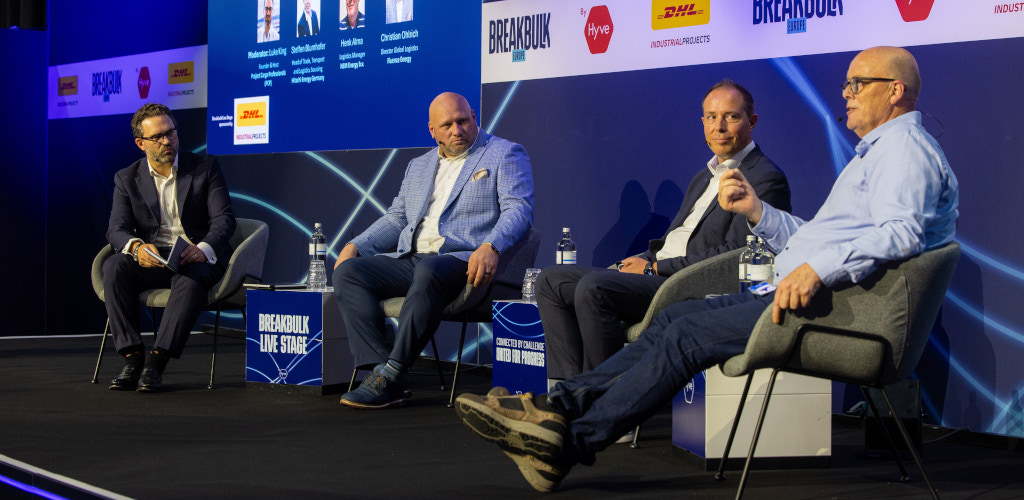
The “What Actually Wins Work? How Shippers Decide” session, moderated by Luke King, founder and host of the Project Cargo Professionals podcast, featured three senior logistics decision-makers: Christian Ohlrich, director of global logistics at Fluence Energy; Steffen Blumhofer, head of trade, transport and logistics sourcing at Hitachi Energy Germany; and Henk Alma, logistics manager at NEM Energy. Between them, they cover battery energy storage, power generation equipment and heat recovery systems — among the fastest-growing cargo categories in the current project cycle.
Blumhofer opened on what actually decides an award when two providers look roughly equal on paper. “Number one is clearly HSE,” he said. “All our freight forwarders know this — that’s the baseline.” Beyond that, Hitachi Energy runs comprehensive supplier scorecards and performance evaluations. But Ohlrich pushed back on the idea that metrics tell the full story.
“There’s also a feeling that you get in the pit of your stomach that comes from experience,” he said. “If you don’t feel good about who you’re working with, no scorecard in the world is going to help me — because I can guarantee there’s going to be somebody else whose scorecard is just as good as yours.” His conclusion was direct: “This is still very, very much a people business.”
.jpg) Alma drew on his 30 years in the industry, and described the transformation in project freight forwarding quality as dramatic. “Back then it was a bit of a Wild West,” he said. “Companies would promise you gold and the moon, and things didn’t pan out.” What he sees today is a sector that has professionalized, with engineering functions, structured health and safety programs, and a shift from promises to demonstrated capability.
Alma drew on his 30 years in the industry, and described the transformation in project freight forwarding quality as dramatic. “Back then it was a bit of a Wild West,” he said. “Companies would promise you gold and the moon, and things didn’t pan out.” What he sees today is a sector that has professionalized, with engineering functions, structured health and safety programs, and a shift from promises to demonstrated capability.
Ohlrich drew a distinction between two types of provider: the specialist project forwarder, and the general freight forwarder that has bolted on a project logistics department. “There was a very steep learning curve for some of those people,” he said. “With time you gain experience, and you get better — but it took some of them a while to recognize what we specifically need.”
On loyalty, all three panelists were consistent. Alma revealed that, at one stage, NEM found itself with 80 logistics service providers in its portfolio. “That’s way too much for a company our size,” he said. “So we trimmed that down, because I believe we need to build a relationship — and we will not switch just like that. We are demanding a lot of them as well.”
The session also covered the increasingly complex cargo profiles each company is managing, and how logistics requirements are changing in response. Ohlrich described how Fluence has responded to the industry trend of going bigger and heavier: While competitors are pushing 50, 60 and 70-tonne container-based units, Fluence deliberately broke its product apart. “We’re now delivering 100 tonnes in five pieces of around 20 tonnes each,” he said. “Like Legos — you stick the batteries on top.”
Blumhofer described a shift from transactional, project-by-project logistics to a structured partnership model, with Hitachi Energy now working with key suppliers on three-, five- and ten-year planning horizons. Alma flagged the regulatory burden of CBAM (carbon border adjustment mechanism) compliance as a growing operational headache for a company of NEM’s size, warning that many in the industry are still underestimating what it will require.
The session closed with each panelist offering advice for providers looking to win more business — with a request to avoid the obvious. Ohlrich made the case for engineering-led, bespoke problem-solving, describing a custom lifting device developed with a forwarder that allowed his team to unload 400 heavy units in two days. “That’s the kind of value-added service I’m looking for,” he said.
Blumhofer kept it simple: “Be honest. If you’re lacking in experience or organization for a particular project, I’m more open to hearing that than having a discussion later about why it didn’t work out.”
Alma agreed and added one more requirement. “Study our product,” he said. “Go to our website. Find out what we actually do — and then come to me with a good storyline. Don’t come to me with an email saying you can do some trucking...”.
Top photo (L-R): Luke King, Christian Ohlrich, Steffen Blumhofer, Henk Alma. Credit: Richard Theemling Photography
Second: Steffen Blumhofer offers valuable guidance for logistics providers. Credit: Richard Theemling Photography






.png?ext=.png)








.png?ext=.png)







_1.jpg?ext=.jpg)