Hatch’s Ayman Elbanan on Why Having a Plan B Is Not Enough
By Ayman Elbanan
Through a strategic practitioner’s lens, Hatch Logistics’ global experts explore the forces shaping project and breakbulk logistics: from risk and execution to geopolitics, sustainability and decision-making in complex cargo environments.
From Issue 4, 2026 of Breakbulk Magazine

In project logistics, we used to preplan our routes a few months in advance. Today, we can find ourselves reevaluating them weekly.
Working as one of the project delivery teams at Hatch gives us a front-row view of this change. We move heavy-lift modules, oversized equipment and critical long-lead items. These are not shipments that can simply be rerouted overnight or replaced on short notice. And when a major shipping corridor becomes unavailable, it is no longer just a logistics problem. It becomes an engineering, procurement, construction and schedule problem.
When Plan B Is Not Good Enough
The response to disruption was simple for decades. If one corridor was choked, we used another. The logic only works if the alternative is still trusted.
Today, projects are increasingly faced with the need to address disruption in multiple corridors simultaneously. A contingency route may in turn depend on another exposed port, strait or overland corridor. A Plan B that depends on another vulnerable corridor is not really a Plan B.
The Real Cost Is Uncertainty
Freight rates and insurance premiums attract attention as both are visible. But in project logistics, the bigger impact can be elsewhere. Change the port of discharge and you may need new route surveys, permits, customs arrangements, heavy-haul engineering, bridge assessments, civil works and construction-interface planning.
In one of our shipments, the proposed port of discharge was changed three times in approximately six weeks, with each change triggering another cycle of assessments and coordination. The lesson was simple: Route uncertainty becomes project uncertainty.
Alternative Routes Must Be Engineered
We are increasingly evaluating alternative gateways and overland corridors to maintain optionality when traditional routes become constrained. On a map, an alternative corridor can look straightforward. Moving heavy and oversized cargo through it may require cross-border customs coordination, road surveys, bridge assessments, civil modifications, permits, specialized transport equipment and continuous engagement with authorities.
The alternative route cannot simply sit in a contingency plan. It must be engineered. Ideally, before we need it.
Logistics Moves Upstream
This is where I believe engineering, procurement and construction management (EPCM) projects should go. Logistics should not start after engineering and procurement decisions have already been made. A package’s size determines whether it can be transported. Routing is affected by supplier locations. Port capabilities drive modularization. Road constraints affect engineering. Delivery sequencing affects construction. So, logistics must have an impact on these decisions much earlier.
The question is no longer just: “What is the most efficient route?” It becomes increasingly: “What combination of routes makes this project doable when things change?” This means designing two or even more corridors, not one preferred route. It means bringing logistics decisions into engineering and procurement at an earlier stage. And that means testing logistics strategies throughout the lifecycle of the project, instead of treating contingency planning as a one-off activity.
The Bottom Line
The chokepoint era does not end with the opening of one shipping lane. For projects, it ends when we stop treating resilience as an aspiration and start treating it as an engineering requirement. Logistics is more than simply moving cargo in the best possible way. It’s about making sure the project is executable when the best way is no longer there.
Ayman Elbanan is the regional logistics manager, Middle East & Africa, for Hatch. He has almost 20 years of experience at DSV, CMA CGM, CEVA and Agility, having led multi-country teams and delivered complex heavy-lift projects for major energy, industrial and EPC customers across the region.
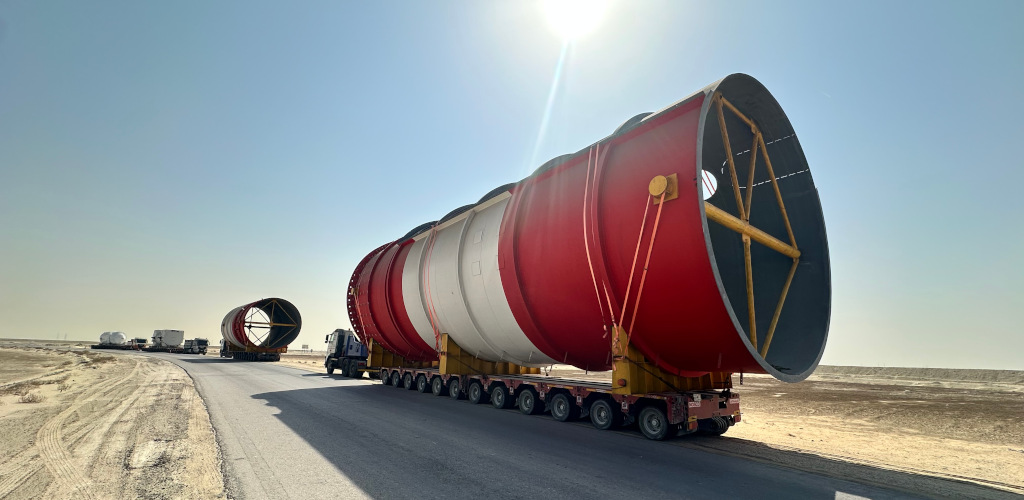
Top photo: Hatch transports project cargo across Saudi Arabia. Credit: Hatch