How One Logistics Manager Spent Five Years Delivering East Africa’s Biggest Power Station
By Luke King
Maher Said of Elsewedy Electric PSP offers an inside look at the extraordinary logistics operation behind the Julius Nyerere Hydropower Project, a complex, multi-partner effort supported by CEVA, Mammoet, Kuehne+Nagel and Fracht.
(5-minute read)
“On a project the size and complexity of the Julius Nyerere Hydropower Project, logistics was far more than a support function: It directly influenced engineering progress, construction sequencing, financial performance and, ultimately, the entire project’s credibility.”
.jpg) Logistics manager for one of the most consequential infrastructure projects in African history, Maher Said speaks with authority. When the Egyptian joint venture of Arab Contractors and Elsewedy Electric Power Systems Projects won the contract to design and build Tanzania’s US$2.9 billion JNHPP, a 2,115-megawatt (MW) facility on the Rufiji River that would more than double Tanzania’s installed generation capacity, Said was there from the beginning.
Logistics manager for one of the most consequential infrastructure projects in African history, Maher Said speaks with authority. When the Egyptian joint venture of Arab Contractors and Elsewedy Electric Power Systems Projects won the contract to design and build Tanzania’s US$2.9 billion JNHPP, a 2,115-megawatt (MW) facility on the Rufiji River that would more than double Tanzania’s installed generation capacity, Said was there from the beginning.
“I shifted my office to Dar es Salaam permanently for five years,” he told Breakbulk. “All freight forwarders and transporters had weekly meetings to follow up, discuss current and potential challenges, and set short- and long-term plans.”
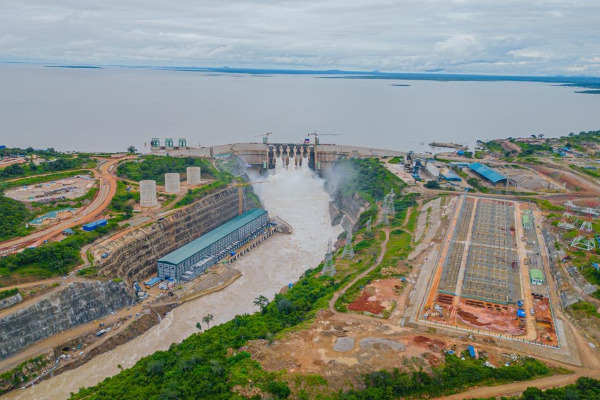
The project’s scale demands some context. The JNHPP, located within what is now the Julius Nyerere National Park in eastern Tanzania, comprises a 134-meter-high concrete dam stretching more than a kilometer at crest level, four auxiliary saddle dams, nine turbines each generating 235 MW, and a 400-kilovolt (kV) transmission line connecting to the national grid.
Construction began in 2019 following site handover by the Tanzanian government, with the first turbine injecting power into the national grid in February 2024 and full commercial commissioning of all nine units completed in March 2025. The dam is now the fourth largest in Africa and the largest power station in East Africa.
The project was awarded to the Egyptian consortium following diplomatic negotiations between Presidents Magufuli and el-Sisi, under a bilateral South-South cooperation framework. Elsewedy Electric PSP, the EPC arm of Cairo-headquartered Elsewedy Electric, served as overall engineering manager, with responsibility for procurement, construction management, and supply chain across the entire project lifecycle. Said, who progressed from logistics specialist to logistics manager over the course of the project, was the man responsible for getting everything to site.
No Easy Route
When Said joined the project in 2019, his immediate task was to identify the risks before the first shipment moved. What he found was a logistics environment that offered almost no margin for error. The project site sits deep within a former game reserve, accessible by a gravel road from the nearest railway station at Fuga, itself 220 kilometers by rail from the port of Dar es Salaam. There was no paved road connecting the port to the construction site.
“Safety was the overriding concern from day one, especially considering infrastructure gaps, regulatory challenges, route readiness and seasonal constraints,” noted Said. “We put strategic partnerships in place with the biggest transporters in East Africa, and most of them started early to improve their systems and increase their fleet based on contracts signed with them.”
Chief among the key supply chain partners were CEVA Logistics and Mammoet, who were heavily involved in the logistics execution across what Said divided into five distinct project phases, structured around cargo volumes, delivery schedules, equipment availability and seasonal weather patterns. CEVA provided forwarding and integrated supply chain services, while Mammoet, a world leader in heavy lifting and transport, handled the most demanding heavy cargo moves at and around the site.
“From day one, the flow of cargo defined the pace of the entire project,” Said says. “Before the first cargo even arrived, we had to coordinate port readiness, customs pathways, railway-crossing solutions, bridge reinforcement, heavy-haul routing and last-mile engineering modifications. Without those measures, the cargo simply would not have reached site.”
To monitor the entire chain, Said established what he describes as “an integrated global supply chain control tower in Cairo, monitoring every shipment from factory readiness to site delivery.” Internally, the team relied on their MTS and ERP platforms; externally, they integrated directly with key freight forwarder systems, including those of CEVA, as well as Kuehne+Nagel, and Fracht, to enable real-time GPS tracking for land transportation.
The Railway Problem
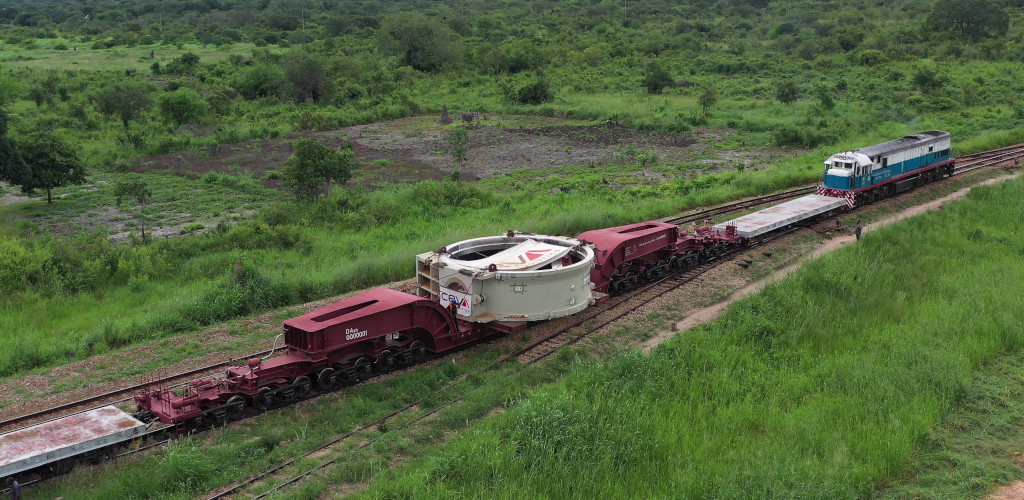
 Of all the challenges Said faced, the most consequential, and ultimately the most innovative, was what to do about the heaviest cargo. The nine turbine assemblies, each weighing up to 200 tonnes and measuring eight meters wide, could not travel by road. Tanzania’s infrastructure in that corridor was simply not built for it, and rail was the only viable option.
But TAZARA, the Tanzania-Zambia Railway Authority, the historic line linking Dar es Salaam to Zambia’s Copperbelt, was not built for the task either. Its conventional wagons could carry a maximum of 60 to 90 tonnes.
“The mode of transport by road from the port to site wasn’t suitable at all to accommodate the weights and dimensions involved,” Said explains. “But we found that railway access from the port of Dar es Salaam to Fuga station, located 38 kilometers from the site, was a very good option for lighter cargo. For the heavy lifts, we worked out how to upgrade the railway infrastructure and then assigned a Chinese supplier to design a new well wagon capable of carrying 200 tonnes, based on transportation drawings for the heaviest packages.”
The solution Said describes is confirmed by TAZARA’s own public records. In January 2023, TAZARA announced the acquisition of a custom-built 200-tonne well wagon, manufactured by CRRC Qiqihar Railway Rolling Stock of China specifically for JNHPP turbine components. According to a TAZARA statement, the wagon was purchased at a cost of approximately US$1 million, with financing arranged through the joint venture.
Said adds that his team identified the need, sourced the wagon design, and drove the procurement process, embedding Elsewedy’s own structural engineers within TAZARA’s team to ensure the railway infrastructure could handle the loads.
“By owning the well wagon, upgrading the infrastructure, and putting our structural engineers together with the TAZARA team, we achieved full capacity utilization of the TAZARA corridor,” he says. “The real pressure points emerged at the interfaces, between our freight forwarders and the ports, the ports and TAZARA, TAZARA and the Tanzanian road network, the road network and the national park, and finally between logistics and installation. Managing those transitions with precision allowed the project to maintain momentum.”
When the World Stopped
Said joined the project in 2019, the same year construction began and the same year a pandemic was gathering momentum that nobody yet knew about. By the time COVID-19 struck in 2020, the project was in full mobilization. The consequences were severe.
“The project was signed in December 2018,” he says. “Then in 2020, during mobilization, we faced the global crisis. It was tough. The risk management function at our corporate level was under real pressure to measure the risks and give us direction. Our top management was visiting the project monthly to check and calculate the risks, especially in the supply chain.”
The frequency of those management visits speaks to the strategic importance the project held for Elsewedy Electric at the corporate level. Said describes a response that divided the project into discrete packages, each treated as a self-contained project with its own dedicated team and budget, calibrated against the rapidly changing global environment.
“Our cost control and risk teams split the project into packages and considered each one as a separate project with a dedicated team and budget based on the prevailing global situation,” he says. “We controlled the packages with the highest risk, and our contract supported an adjustment option for strategic materials based on local market rate changes, which was a critical mechanism for recovering adjustment payments from the project owner.”
That contractual flexibility proved essential. The project ran from 2019 to 2025, a period that encompassed not only the pandemic, but also global supply chain disruption, commodity price inflation and significant freight rate volatility to boot. That the project was delivered without a single logistics failure, Said says, is a source of deep professional pride.
What Gets Left Behind
Asked to identify the milestones that best capture the complexity of what his team accomplished, Said does not reach for a single dramatic moment. He lists them methodically: remote geography and activating logistics operations in undeveloped areas; the transportation of more than 500 overweight and over-dimensional packages over roads designed for nothing of the kind; unpredictable climate; the coordination between government and private sector to purchase and then gift a capital asset — the well wagon — to a national railway authority; multi-agency coordination; and zero-tolerance deadlines at every stage.
That logistics success story is now part of the permanent history of a dam that has been decades in the making. The JNHPP was first conceived in the 1960s, when Tanzania’s founding president Julius Nyerere identified the gorge at Stiegler’s Gorge on the Rufiji River as the site of a future national power station. Plans were drawn, studies commissioned, and then abandoned — blocked by World Bank opposition, environmental objections and a lack of financing.
It took until 2017 for President John Magufuli to revive the project with the political will to see it through, and until 2025 for all nine turbines to reach full commercial operation. The dam now generates 5,920 gigawatt hours of power annually, effectively doubling Tanzania’s national grid capacity and positioning the country as a potential regional power exporter.
For Said, who watched it all come together one convoy at a time from his office in Dar es Salaam, the project is simply the most demanding and most important thing he has ever done. “It was six years of operations, executed without failure,” he proudly concluded.
Top photo: Heavy equipment is transported to Tanzania’s JNHPP. Credit: Elsewedy Electric PSP
Second: Maher Said, who oversaw logistics for the JNHPP. Credit: Elsewedy Electric PSP
Third: The JNHPP is one of Africa's largest hydropower dams. Credit: Elsewedy Electric PSP





.png?ext=.png)









.png?ext=.png)









_1.jpg?ext=.jpg)