Steelmakers Are Investing Billions, but Costs and Infrastructure Are Slowing Transition
By Amy McLellan
Europe’s steelmakers are betting billions on a new way of making steel, replacing fossil fuels with cleaner production methods. But high costs and infrastructure constraints are slowing the transition.
From Issue 3, 2026 of Breakbulk Magazine
(5-minute read)
It’s been another difficult year for the European steel market. While figures show the first signs of recovery in 2025, reversing three consecutive years of declining consumption, the reality is the EU consumed more steel last year but produced less.
EU crude steel production fell by 2.9% to 125.8 million tonnes, the lowest level ever recorded — almost 20 million tonnes below pre-pandemic levels and nearly 60 million tonnes lower than before the 2008 financial crisis. This meant the uptick in consumption benefited importers rather than domestic producers.
It’s another signal of the growing pressure on European steelmakers, who find themselves in the crossfire of high energy costs, weak industrial demand and intense competition from lower-cost international rivals.
According to a note from Alessandro Sciamarelli, director of market analysis and economic studies at the European Steel Association (EUROFER), the outlook is “fragile,” with consumption growth dependent on the wider economic and geopolitical environment, which remains “broadly unpredictable”.
Climate change is adding to the industry’s woes. This summer’s drought impacting large swathes of the continent left key waterways low on water, affecting logistics. In Germany alone, inland waterways handle about a third of the steel industry’s total transport volumes, making Rhine navigability critical to maintaining competitive operations.
“The ongoing low-water situation continues to affect the supply of raw materials to our Duisburg site and our logistics processes,” said a spokesperson for thyssenkrupp Steel, who stressed that customer supply is “currently not at risk”.
“Our own push-barge fleet operations remain suspended due to the low water levels. As a precautionary measure, we are currently using chartered external vessels that, due to their shallower draft, can be deployed even at the current water levels.” Additional capacity on road and rail is also being deployed, he added.
Green Steel: Big Ambitions, High Costs
 To these challenges must be added the pressure to decarbonize, which hits hard for energy-intensive steel manufacturing. According to EUROFER, Europe’s steel industry is attempting one of the most ambitious industrial transformations ever undertaken. European steelmakers are investing billions of euros to fundamentally redesign how steel is produced, replacing fossil fuels with low-CO2 electricity, hydrogen and more circular production models.
Some projects focus on reducing fossil carbon use through process integration, fossil fuel substitution, carbon capture and utilization (CCU) and carbon capture and storage (CCS).
Others aim to avoid carbon emissions directly by replacing traditional blast furnace production with hydrogen-based direct reduced iron (DRI), electric arc furnaces (EAFs) and electric smelter furnaces (ESFs) powered by low-CO2 electricity.
Among these technologies, hydrogen-based DRI combined with electric steelmaking is emerging as a key solution. EUROFER estimates that 13 direct reduction plants (DRPs) and 20 EAFs with an annual capacity respectively of 26.9 million tonnes and 44.1 million tonnes of low-CO2 steel could be operational by 2035.
Although a handful of DRPs are in the construction phase and expected to be operational between 2027-2030, the majority of projects are facing delays due to Europe’s high natural gas and electricity costs and the slow scale-up and high costs of hydrogen production. High electricity prices are also affecting investment decisions in EAFs.
As a result, Europe’s steel transition is no longer simply a technological challenge. It has become a question of industrial competitiveness.
“The transition to lower-carbon steel production is much more complex than simply replacing coal with hydrogen,” said Yasmina Rauber, former general secretary at the ZCA (Zug Commodity Association). “Steelmakers are being asked to transform almost their entire production process while continuing to operate in a very difficult and competitive market.”
EUROFER estimated in 2022 that the transition would require €31 billion in capital expenditure and at least €54 billion in operating expenditure through 2030. These funds would be committed while there is still considerable uncertainty around the availability and future cost of hydrogen, the necessary energy infrastructure, government support and demand for green steel.
“Although some customers may be willing to pay a premium, many are not yet ready to absorb the additional cost,” Rauber said.
Project Headwinds
These cost pressures are creating real headwinds for Europe’s green steel ambitions.
Germany’s thyssenkrupp Steel, for example, has had to adjust the funding conditions and operating plans for its tkH2Steel hydrogen plant, which is designed to replace coal-based blast-furnace production at its Duisburg site with hydrogen-based direct reduction and electric melting technology. The site is Europe’s largest integrated iron and steel facility.
Around two-thirds of the €3 billion project cost is being supported by the German federal government and the state of North Rhine-Westphalia. The original funding conditions were closely linked to the use of renewable hydrogen.
However, the lack of affordable hydrogen has made the original timetable unrealistic. In late-August, Reuters reported that the European Commission had approved changes to the funding arrangements that would allow thyssenkrupp to use natural gas during the plant’s initial operating phase before transitioning to hydrogen at a later date.
Stegra Makes Progress at Boden
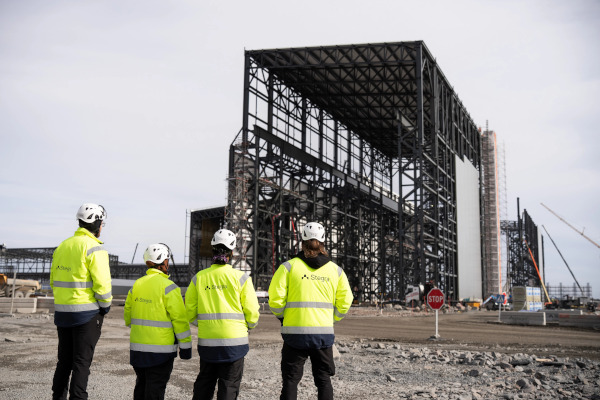 Stegra, meanwhile, is forging ahead with its green hydrogen and 5-milliontonnes- per-year green steel project at Boden in northern Sweden. The project comprises three connected factories or green production platforms: one for hydrogen, one for direct reduction of iron, and one for steelmaking, spanning 270 hectares.
“Daily construction and installation activities are ongoing in the different parts,” said a spokesperson. “Our timeline is currently under review, but we’ve reached several milestones lately. For example, our DRI tower reached its full height of 145 meters earlier this summer, even though there is still work ahead with continued installations.”
Logistics are clearly key on a project of this scale. According to the company, planning, timing, execution and deliveries are something that “permeates everyday life in the project.”
“One example of bigger and heavier deliveries to our site before they are installed are the process gas tanks that are needed for the production processes,” the spokesperson said. “They have been shipped to a nearby port and then transported by road to our site with special transport. Earlier this year we and our suppliers carried out several of those transports with a 70-meter-long trailer to spread the weight of a couple of hundred tons per equipage.”
The construction of the 145-meter-high DRI tower has involved a number of heavy lifts.
“We have been pre-assembling smaller pieces into bigger modules before they have been lifted and assembled in the tower as it has grown upwards,” said the spokesperson. Other parts of the plant have used other types of cargo methods and logistics chains. “We have individual parts of our plant that have been delivered to us in hundreds of conventional containers before they have been assembled and installed.”
While this is a remote area, it is relatively close to several ports. “The fact that we can use several different ports and interim storage areas creates redundancy and flexibility,” the spokesperson continued. “The construction site is also well connected to the road network and is adjacent to the national railway grid in Sweden. As always when transporting big stuff, special transport is preceded by careful and precise planning, calculations and cooperation between different stakeholders where the key is safety.”
SSAB’s Fossil-Free Drive
Also in Sweden, SSAB is moving towards cleaner steel production, investing €4.5 billion to transform its traditional blast-furnace steel plant in Luleå into a modern, electrified mini-mill.
The project remains on schedule and within budget, despite two precautionary pauses in groundworks: The first followed reports of illness symptoms among contractor personnel in April, while a second was triggered in June after personal gas detectors recorded low levels of hydrogen cyanide (HCN). Activities resumed gradually from July, and SSAB continues to target production start in late 2029.
SSAB is also converting its Oxelösund facility to EAF production, with the new unit scheduled to start production in Q2 2027. Separately, the company has committed SEK 3.3 billion over four years to a new quenching and tempering line at the site, with production scheduled to begin in 2030.
Elsewhere in Europe, Hydnum Steel recently secured a €150 million investment commitment from COFIDES for the first clean steel plant in the Iberian Peninsula, with an annual production of 2.7 million tonnes powered by green hydrogen and 100% renewable energy.
The €1.5 billion project in Puertollano will see earthworks and construction get underway before the end of the year.
The Green Steel Ecosystem
The transition to green steel involves more than the construction of new plants; it also relies on a whole ecosystem from power lines to hydrogen infrastructure, which must be developed simultaneously with new EAFs.
Hydrogen adds new challenges: it has different physical properties to natural gas and therefore requires dedicated infrastructure and specific safety measures. Storage facilities, terminals and pipelines must either be designed specifically for hydrogen or adapted to accommodate hydrogen transport and storage.
The port of Rotterdam, the region’s largest port complex, is positioning itself to be a northern European green hydrogen hub, with ambitions of 2 to 2.5 gigawatts (GW) of electrolysis capacity in the coming years.
“Rotterdam has moved from planning into execution,” a spokesperson said. “Significant progress is being made in developing the conditions needed for a large-scale hydrogen economy, including land allocation, infrastructure development, offshore wind connections, import facilities and connections to industrial users. While Rotterdam’s targets for hydrogen imports and production of 4.6 million tonnes remain in place, timelines may shift. What was initially foreseen for 2030 may realistically move towards 2035.”
Rotterdam’s hydrogen value chain is further ahead than foreseen five years ago, the spokesperson said, pointing to a growing number of hydrogen projects now under development or construction in the port area. Shell’s 200-megawatt (MW) electrolyzer will start-up at the end of this year, while Air Liquide’s 200-MW electrolyzer will begin in 2027.
“The hydrogen pipeline through the port area is completed and other plans for which we reserved space in the port are being developed,” the company said.
The build-out of the hydrogen economy also creates substantial demand for breakbulk and project cargo logistics. Electrolyzers, transformers, offshore wind components, storage tanks and industrial equipment are often transported as oversized or heavy-lift cargo through ports such as Rotterdam.
Still, challenges remain, the company said, including uncertainty about the regulatory regime.
“Hydrogen projects require both sustainability targets and a strong economic case,” the spokesperson said. “The transition must support industrial decarbonization while preserving Europe’s industrial competitiveness. The challenge is therefore not only producing hydrogen, but building an entire ecosystem including generation, import, storage, transport and demand at the same time.”
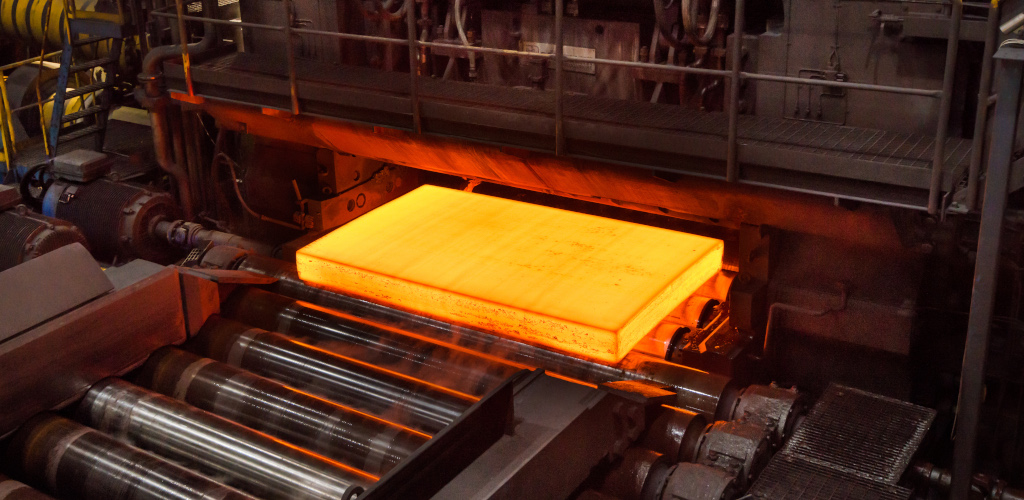
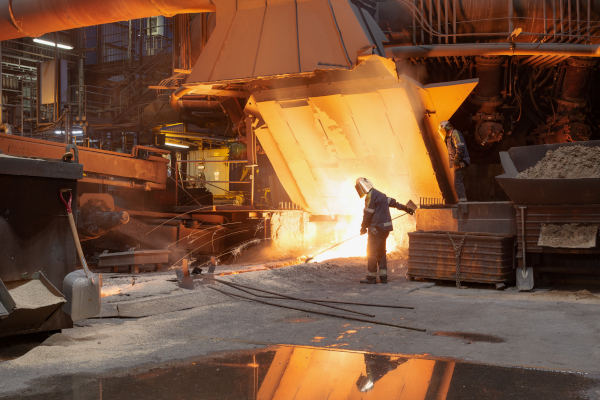
Top photo: SSAB Oxelösund produces a small, test batch of heavy plate steel using hydrogen-reduced sponge iron. Credit: SSAB
Second: A traditional blast furnace at SSAB's Oxelösund works, Sweden. Credit: SSAB
Third: Workers oversee building work on Stegra‘s green steel plant at Boden. Credit: Stegra


.png?ext=.png)


.png?ext=.png)


_1.jpg?ext=.jpg)