Cosmatos Group and Mammoet Deliver Critical Refinery Unit for EKME
By Malcolm Ramsay
Cosmatos, Mammoet and EKME share insight into a Herculean project worthy of Greek myth: moving a towering 210-tonne refinery unit to Aspropyrgos.
From Issue 2, 2026 of Breakbulk Magazine.
(5-minute read)
In Greek mythology, the Medusa was a monster so formidable that defeating her required intelligence and precision rather than brute force. While Perseus was ultimately able to use the reflection in his shield to avoid being turned to stone, this option was not open to project forwarder Cosmatos Group, heavy-lift specialist Mammoet and industrial equipment manufacturer and contractor EKME when they were tasked with their own modern-day Gorgon, transporting a giant 210-metric-tonne refinery unit in Greece.
Too tall for roads, too heavy for standard barges, and too critical to fail, the Medusa heavy-lift project was undertaken as part of a major upgrade to Helleniq Energy’s Aspropyrgos Refinery, a linchpin in Greece’s energy infrastructure. Located just 30 kilometers northwest of Athens, near the port of Aspropyrgos, the refinery is responsible for processing 65% of the country’s crude oil, making it a cornerstone of both domestic and regional energy security.
Cosmatos Group, a member of The Heavy Lift Group, was brought into the project by EKME, a global player in petrochemical fabrication, due to its proven expertise in navigating complex, high-stakes transport moves, and from the outset this project presented a number of challenges.
“The distance between EKME’s fabrication shop and the port of Thessaloniki is about nine kilometers through the city,” Kyriakos Kalis, director at Cosmatos Group, told Breakbulk, explaining that height restrictions meant that two giant units had to be carefully moved from the fabrication facility for final assembly at the port of Thessaloniki.
Once combined into the Medusa unit, the entire component was then shipped by barge to the refinery’s port of Aspropyrgos for onward delivery to the Helleniq facility.
Modern-Day Gorgon
 At the core of the operation was the EKME-fabricated top head and cyclone unit, a monolithic structure weighing 210 metric tonnes and measuring 14.2 meters long, 8.73 meters wide and 8.73 meters high. The unit’s sheer size and weight, combined with the need to assemble it portside before transport, pushed the boundaries of what was logistically feasible.
“The most challenging points from a design and manufacturing point of view were the design and connection of the plenum chamber stub-outs with the secondary cyclones and the primary cyclones connection to the plenum chamber bottom ring,” said Yannis Karyotis, CEO of EKME.
The top head and cyclone system is a critical component of a refinery’s fluid catalytic cracking (FCC) unit, which converts heavy, high-boiling hydrocarbon fractions from crude oil into lighter, more valuable products such as gasoline and diesel. Located in the reactor vessel, the cyclones act as a containment and separation system for the catalyst and hydrocarbon vapors.
The system is engineered to operate under severe conditions, with temperatures typically exceeding 500°C and pressures of around 1.5–3 bar, while maintaining high separation efficiency and minimizing catalyst losses.
The journey of the Medusa unit began in EKME’s fabrication facilities in Thessaloniki, Greece’s second-largest city and a major industrial hub. This was the sixth such project that EKME has undertaken in the past twenty years, which provided the necessary infrastructure and expertise for the complete build.
Typically, the top head and cyclones are delivered separately to site and assembled there ahead of the refinery turnaround, when installation takes place. However, in this particular project, time and space constraints within the refinery meant that the entire top head and cyclones package had to arrive fully preassembled.
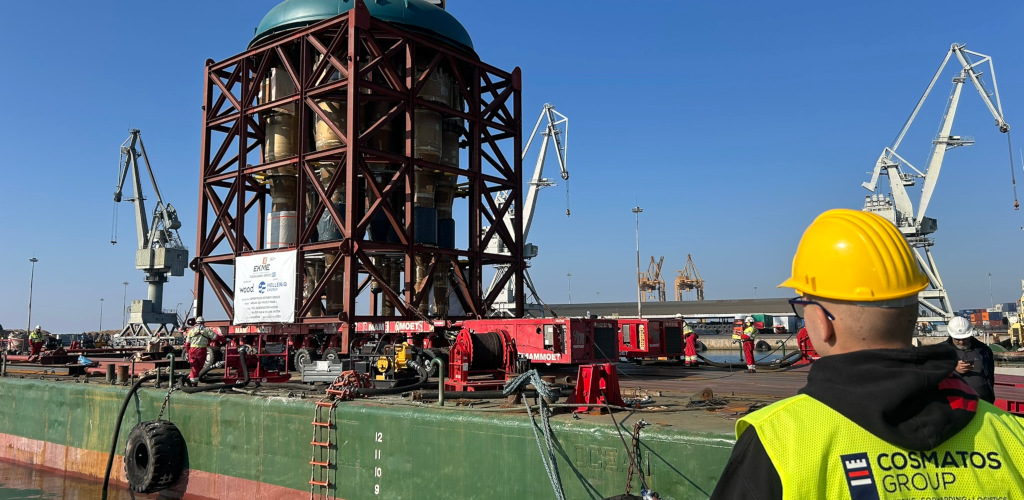
Transport limitations required the partners to move the top head and cyclones sections separately by self-propelled modular transporter (SPMT) to the port, where they were assembled dockside before being transferred onto a PRO CB 100 barge measuring more than 70 meters in length.
“Once it was decided that barge transportation was the only feasible solution, discussions were initiated through frequent team meetings,” Karyotis said. “Site visits at the ports, along with engineering studies to assess pier strength and identify a suitable barge, were considered critical factors in the project’s decision-making and follow-up.”
With over 50 years of experience in manufacturing pressure equipment and skid-based units for oil and gas refineries, energy and industrial sectors, EKME was well prepared for the large-scale fabrication involved and worked closely with heavy-lift specialist Mammoet to devise a suitable transporter configuration to move the prefabricated pieces to the port of Thessaloniki.
“An SPMT with 20 axle lines was used,” Kalis said. “As per the method of statement (MOS), this was the appropriate equipment to ensure that the load-in and load-out operations were performed safely. Pier and barge strength were taken into consideration in the MOS in order to determine the configuration of the equipment to be used.”
With the top head and cyclones ready for load out at the fabrication site, the team then had to ensure the route was clear and all calculations complete to ensure the swept-path and load-bearing tolerances were accurate. “The new top head was transported from the site to the port early on a Sunday morning, in accordance with police instructions,” Kalis added.
Building the Medusa
 Upon arrival at the port of Thessaloniki, the giant top head unit and cyclone units were then positioned for the final assembly of the combined Medusa unit.
“We have good cooperation with the port authority regarding the necessary area availability, the logistical support necessary and the supply of lifting equipment and other apparatus,” Karyotis said. “In this case, proper transportation box and bracings design, and the selection of the area of final assembly within the port, were the key points to ensure secure handling. As was of course the selection of Mammoet, an experienced world leader in heavy haul and lifting operations, as the transportation subcontractor to perform the loading and land and marine transport activities.”
With the unit finally assembled, it then had to be transferred to barge for onward transport to the port of Aspropyrgos.
“A mobile ramp was placed between the barge and the pier to achieve the most efficient loading operation,” Karyotis said. “The Marine Warranty Surveyor (MWS) supervised the welding and nondestructive testing of the mooring equipment and the spreader beams on the barge. Further on the predicted welding procedures, additional welding was carried out on buckled areas of the barge’s deck plating.”
Detailed pre-planning by the teams also identified the cyclone leg connections as a potential weak point. By calculating the relevant elevations in relation to the transportation frame, the partners were able to ensure a sufficiently stiff structure capable of withstanding accelerations and movements during both land transport and, in particular, the sea voyage.
“The successful design was the product of a close cooperation between EKME’s team and the experienced supplier of the cyclones, Van Tongeren, from England,” Karyotis said.
Complex Ballasting
Transporting the giant unit by barge avoided many of the obstacles associated with road transport, but it also introduced a unique set of challenges, as the immense weight of the component made precise ballasting of the barge critical.
“Mammoet personnel were monitoring the ballasting operation,” Karyotis said. “The load-out was stopped from time to time to allow proper de-ballasting and upon loading the top head, the water ballast was discharged.”
To achieve the perfect equilibrium required for safe transport, counterweights were strategically added at the aft section of the barge, though their placement had to be adjusted slightly from the original MOS specifications. This fine-tuning was essential to eliminate any tilt and maintain the calculated trim, the optimal balance between the barge’s bow and stern.
The need for these adjustments arose from unexpected weight discrepancies, as the barge’s own equipment, combined with the heavy-lift gear provided by Mammoet, added more mass than initially accounted for in the plan. With every kilogram counting, even minor imbalances could compromise stability during transit.
Alongside the challenges of ballasting, weather conditions were also a key factor, and due to unexpected delays in the barge’s arrival, the project had to be postponed to the autumn period — a riskier season for maritime transport. Nonetheless, the team adapted with enhanced weather monitoring and additional safety checks, proving that even the best-laid plans must bend to the elements.
Upon arrival at the Port of Aspropyrgos, the Medusa unit was offloaded and transported the final few kilometers to the refinery. “Phase 2 involves the installation of the Medusa assembly onto the existing reactor and is currently being executed at the client’s premises,” Karyotis said.
This upgrade is part of a €130 million investment to modernize the refinery, reducing emissions by 50% and enabling the processing of heavier, high-sulfur crudes, critical in meeting EU environmental standards and securing Greece’s energy future.
The surge in large-scale modular projects will be the focus of a panel discussion at Breakbulk Europe 2026. How Modularized Mega Projects and Emerging Industries Are Redefining Breakbulk’s Future Mix, moderated by Fluor’s Ben van der Hoeven, will take place on the Breakbulk Live Stage on Thursday 18 June from 10:45am to 11:30am.
Top photo: A Cosmatos worker oversees the transport of the 210-tonne unit. Credit: Cosmatos Group
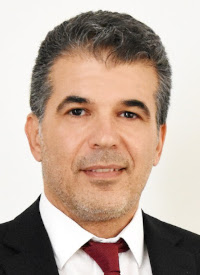
Second: Yannis Karyotis, CEO of EKME. Credit: Karyotis
Third: Kyriakos Kalis, director of Cosmatos Group. Credit: Cosmatos Group


.png?ext=.png)



.png?ext=.png)



_1.jpg?ext=.jpg)