Shanghai Hamel Shares Insight on Heavy Equipment Delivery to Indonesia
By Simon West
John He, general manager at Shanghai Hamel Supply Chain Technology, takes us behind the scenes of an operation to transport a shipment of heavy cranes from China to Indonesia. He explains the vessel selection, loading methodology and challenges the team overcame to deliver the cargo safely and on schedule.
From Issue 4, 2026 of Breakbulk Magazine
 Q: Can you give an overview of the project and its objectives?
John He: The purpose of the project was to ship five rubber-tired gantry cranes (RTGs) and two quay cranes from the southern Chinese city of Zhuhai to the Indonesian capital, Jakarta, to ease pressure on the Port of Jakarta and strengthen its loading capacity.
Q: Why was the Zhuhai–Jakarta route selected for this shipment?
JH: The manufacturer is located in Zhuhai and has its own pier for loading and unloading, making our own decker the best choice due to its sufficient flexibility.
Q: What were the dimensions and weights of the five RTGs and two port cranes?
JH: Each RTG measured 26.6 x 12.2 x 29.2 meters and weighed 166 tons, while the bulk components of the port cranes measure 27.0 x 1.84 x 6.39 meters and weighed 105 tons.
Q: Why was the company’s self-owned decker Yong Ao Guo Ji selected for this project? What characteristics of the vessel made it suitable for transporting this particular combination of RTGs and port cranes?
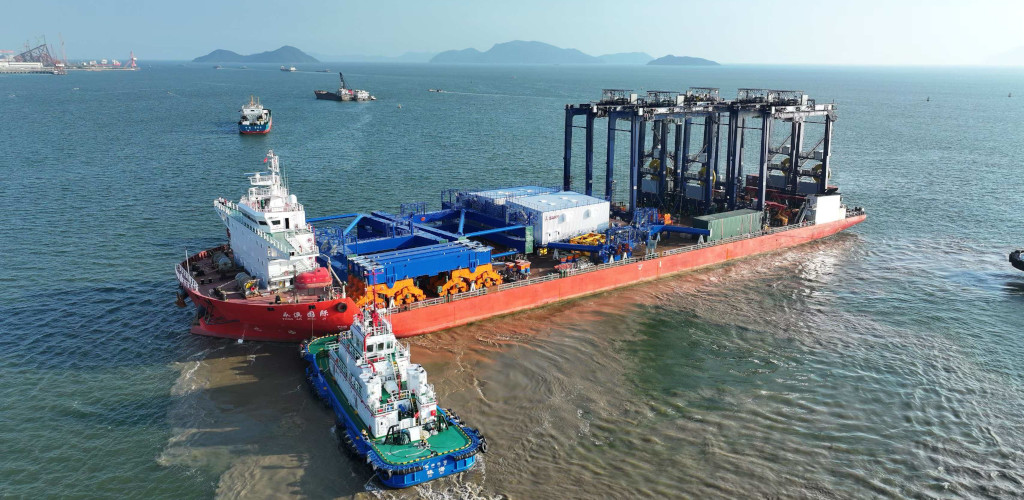
JH: Yong Ao Guo Ji is our self-owned decker for international shipping projects. The vessel is suitable for a wide range of oversized and heavy-lift cargoes and can meet the loading requirements for large port machinery and equipment.
Q: What special lifting equipment, spreaders, lifting beams or other project-specific gear did the cargo require during loading?
JH: We employed a specific loading methodology: The RTGs drove onto the vessel under their own power. The bulk components of the quay cranes were loaded using the SPMT (self-propelled modular transporter) siderolling method. Other smaller and looser parts were lifted onboard by cranes. Given the overall height of the cargo, we deployed supports, chocks, steel wire ropes and other fittings for lashing and securing during operations to ensure stability.
Q: What were the biggest challenges encountered during the planning or execution of the project?
JH: The project was originally scheduled to ship just the five RTGs. Accessories for the quay cranes were added later on an ad-hoc basis. Our team immediately coordinated with the factory to adjust the loading and stowage plan, making every effort to keep the vessel’s departure on schedule while ensuring safe operations.
Q: Looking back at the project, what are you most proud of?
JH: Despite the challenge of additional over-dimensional cargo being added at short notice, the project team completed the loading operations safely and efficiently, ensuring that the customer’s demanding delivery timeline was met.
Shanghai Hamel Supply Chain Technology is an exhibitor at Breakbulk Europe.
Top photo: A tug guides the Yong Ao Guo Ji at Zhuhai before its onward journey to Jakarta. Credit: Shanghai Hamel