Panelists Examine the Realities Behind the Region’s Shifting Energy Mix
_2.jpg)
By Luke King
“Is this the real life, or is this just fantasy?” That line, borrowed from Queen, repurposed for the oil market, set the tone for a main stage session at Breakbulk Middle East, as panelists wrestled with what the Gulf’s shifting energy mix means for project cargo and offshore marine supply chains.
Moderated by Adrian Phillips, member engagement director for the Middle East at the International Marine Contractors Association, the session featured Captain Hussam Farrouq Suyyagh, manager of business excellence at ADNOC Logistics & Services, and Dheeraj Sharma, vice president of marine and offshore regional business development for Middle East and Africa at ABS.
Phillips described a “near-total disconnect” between geopolitical turbulence and commodity prices, with oil at multi-year lows due to accumulated stocks, OPEC+ supply increases and sanction-busting from Russia and Iran. “We’re just not seeing the volume of offshore capital projects that came through maybe two or three years ago,” he said.
Yet the long-term demand picture is clear: energy consumption across the MENA region is expected to rise 50% by 2035, driven by population growth, urbanization and AI data centers, requiring a grid four to five times its current size.
 Hydrocarbons still supply roughly 90% of the region’s electricity, with gas alone accounting for 70%. But ADNOC Logistics & Services is already adapting. Captain Suyyagh highlighted Project Lightning, which has connected ADNOC’s offshore sites via an undersea cable grid, allowing vessels to switch off generators and plug into shore power at the jetty.
The initiative has cut fuel consumption and emissions by 5% to 10% across port operations. “Allowing this energy to arrive to offshore sites will definitely help in the incremental reduction of the carbon footprint,” he said.
Fleet electrification is also accelerating. ADNOC plans to deploy Viceroy seagliders — all-electric, high-speed passenger craft designed to transport personnel to and from offshore energy infrastructure. For larger offshore support vessels, LNG remains the bridge fuel, with new vessel designs already calibrated to IMO’s 2030 and 2040 checkpoints. “2027 is going to be a very big year for ADNOC Logistics and Services,” Captain Suyyagh said.
The IMO regulatory framework, however, remains in flux. Sharma explained that a key MEPC decision was pushed back a full year, blindsiding owners who had been preparing for it. “A lot of owners say, ‘we’ve been preparing for this and now you just changed the goalpost,’” he said. With Europe pushing hard for a global carbon price and Gulf states including Saudi Arabia taking a different position, the outcome of upcoming MEPC sessions is uncertain. “We don’t know actually what’s going to happen, but we do believe there’s going to be a compromise solution.”
Scalability is the deeper problem. Alternative fuels such as ammonia, methanol and hydrogen are available only in limited quantities and at a significant cost premium. “There is no singular fuel which is the answer,” Sharma said. “There’s no silver bullet.” IMO’s adoption of a “well-to-wake” accounting approach, measuring emissions across a fuel’s entire production cycle, has also reduced LNG’s relative appeal as a transition option.
Nuclear drew the session’s most forward-looking discussion. Sharma argued that negative perceptions, rooted in Chernobyl and Fukushima, obscure a long commercial track record, pointing to the NS Savannah, a nuclear-powered passenger vessel that operated safely in densely populated U.S. coastal waters for a decade from the 1960s.
ABS has completed prototype studies with Herbert Engineering Corporation (HEC) on nuclear propulsion for both a tanker and a 15,000-TEU containership, with results showing zero emissions and near-elimination of bunkering over a vessel’s lifetime. “This technology has been there for a long time. It has been tested,” he said.
The panel closed on a note of pragmatic ambition. The energy transition in the Gulf is real, but it is measured. Oil and gas remain dominant, electrification is advancing unevenly, and the regulatory framework for shipping is still taking shape. As Captain Suyyagh put it, ADNOC’s strategy is built on a “transitioning phase” that balances energy consumption with market stability, helping industries grow while keeping costs in check.
Top photo (L-R): Adrian Phillips, Captain Hussam Farrouq Suyyagh, Dheeraj Sharma. Credit: Ulysses&Crew
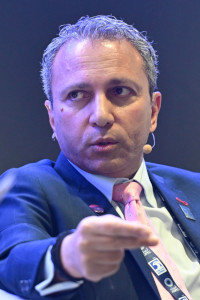
Second photo: Captain Hussam Farrouq Suyyagh. Credit: Ulysses&Crew


.png?ext=.png)


.png?ext=.png)



_1.jpg?ext=.jpg)