Practical Lessons From the Field on Mastering Remote Project Logistics
_1.jpg)
By Jean-François Bourque
After more than two decades tackling complex logistics challenges, Hatch’s Jean-François Bourque offers some brilliant practical advice from the front lines of project delivery.
From Issue 2, 2026 of Breakbulk Magazine.
(7-minute read)
I have learned to spot the moment a remote project becomes “real.”
It is not when the first drawing set is issued, or when the camp is awarded, or even when the financing closes. It is when someone stands in a muddy laydown yard, staring at a piece of critical equipment that has arrived and realizes it cannot be offloaded with what is on site. Or it is when the barge window slips by 48 hours because the tide, the weather and the cargo readiness did not line up. Or it is when a winter road opens and you have eight weeks to move a year’s worth of freight, and half your shipments are still sitting in vendor yards because the fabrication was delayed.
Remote logistics has a way of stripping away the comforting illusion that we can “figure it out in execution.”
At the end of the road, whether it is an ice road, a forestry road, a tide-dependent barge landing, or a gravel access that turns into soup every spring, logistics is not support; it is the backbone of the construction schedule. And if you do not treat it that way early, you will end up paying for it later, when the only options left are expensive, unsafe or both.
Remote supply chains are not complicated. They are unforgiving!
People often describe remote logistics as complex, and it can be. But the bigger issue is that it is unforgiving. The margin for error is thin, and the penalties are disproportionate. A remote supply chain is usually built on three realities:
1. Hand-offs are risk multipliers.
Remote projects rely on multimodal transport: ocean, rail, highway, heavy haul, barging, winter roads and air. Every hand-off, port to truck, truck to barge, barge to beach, yard to convoy, is a chance to damage cargo, lose visibility, or burn schedule.
2. Seasonality is not a constraint — the calendar is.
An ice road season is not “weather dependent” in the way a city project might be. It is a hard operating window. Same for a barge season or a marine corridor. The schedule does not get to negotiate with freeze-up, breakup, tides, or water levels.
3. Infrastructure gaps show up as execution gaps.
Limited cranes, covered storage, mechanics, laydown and power shape how you package, ship, stage and sequence. If you ignore those realities in design and procurement, you will try to solve them on site with overtime and heroics.
I saw remote projects succeed brilliantly, and some bleed quietly for months. The difference is rarely luck. It is whether logistics was treated as an execution discipline early, before the project locked itself into decisions that could not be changed. Here are ways to ensure your next remote project goes well.
Acknowledge that the supply chain is a construction system, and design it like one:
On remote jobs, I think about the supply chain the same way I think about a plant system: define the boundary conditions, the interfaces and control the failure modes.
There are five failure modes I watch for because they are repeat offenders:
• Unknown weights and dimensions that become “surprises” when the route permits are requested
• Packaging that’s treated as paperwork, not protection, and fails halfway through a long chain
• No defined control points: cargo moves, but nobody truly “owns” the hand-offs
• Seasonal windows missed because readiness was assumed instead of verified
• Split accountability: procurement owns contracts, logistics owns movement, construction owns urgency, and nobody owns the outcome
Start at the site and work backward:
 If you want to run remote logistics with discipline, you don’t start at the port or at the fab shop. You start at the laydown yard. Here’s a practical exercise I use early by asking myself, “What does “arrive on site” mean for us?”
For a remote project, “delivered” is not a single event; it’s a sequence where items are delivered to the right location (warehouse vs. laydown vs. point of use), in the right condition (no hidden damage, preserved properly), with the right documentation (traceable, receivable, install-ready), and when the site can handle it (equipment, crews, staging capacity).
If you start the plan from the site-receiving reality, a lot of downstream decisions get cleaner. You stop shipping “when it is ready” and start shipping to required-on-site dates that the field can absorb. You build a 90-day look-ahead that is operational, not aspirational. And, you design your staging strategy with consolidation hubs, buffer yards and campaign shipments timed to windows.
That backward logic also forces uncomfortable but necessary conversations: Do we have enough laydown? Do we need covered storage? Do we need a forklift strategy, not just a forklift? Do we have lifting plans for abnormal loads, not just permits?
Remote projects punish vague answers to those questions.
The chain is only as strong as the weakest link
Practitioners know this, but it is worth stating plainly: the “hardest” segment of the route sets the rules for everything upstream.
If the last 200 kilometers is a narrow forestry road with tight curves and soft shoulders, then your transportable envelope is defined there, not at the fabrication shop. If the last leg is a barge landing with limited beach access and a small crane, then packaging, lift points and rigging plans become design constraints. If the last leg is an ice road, then you do not just plan for weight, you plan for campaign discipline, including pre-positioning, convoy control, maintenance and zero-tolerance for late readiness.
That’s why route surveys and envelope definition are not optional logistics tasks. They are early project design inputs. And this is also where modularization can either save you or trap you.
Modularization: Do not confuse less site work with less logistics work
I am a strong believer in modularization and pre-assembly for remote projects, but I am cautious about how it is sold internally. Too often the logic stops at “modular means fewer hours on site.” That is true, but incomplete.
Modularization shifts work from the site to the supply chain. It concentrates value into fewer, larger, more fragile shipments and raises the consequence of a single failure.
Before you go modular-heavy, ask these questions with brutal honesty:
• Can the route physically support the module size and weight, including seasonal conditions?
• Can you handle it at every transfer point, port, yard, barge, landing, laydown?
• What happens if one module is delayed by two weeks? Is the construction sequence resilient?
• Do you have a preservation strategy for modules that may sit exposed?
• Are your interface points truly frozen, or are you shipping “modules” that still need field rework?
If the answers are weak, the solution is not less modularization, it is better early logistics-led design. Define the envelope, define the interfaces and design modules that are genuinely transportable and install-ready.
Packaging is an engineering control, not a formality
Remote projects break cargo in predictable ways: vibration, shock, repeated craning, moisture ingress, freeze-thaw cycles and long outdoor storage. The insult-to-injury is that the damage often is not visible until commissioning.
That is why I treat packaging and preservation as risk controls. If we can engineer a lifting lug, we can engineer a crate. If we can specify concrete strength, we can specify preservation requirements.
In practice, that means packaging designed for multimodal handling, not a single truck ride; clear markings, lift points and center-of-gravity identification; preservation plans for sensitive equipment that might sit for months; photo records before and after packaging, and inspection points; and storage codes and handling instructions that survive a season outdoors.
When packaging is done well, the field feels it immediately. There are fewer claims, fewer surprises, fewer “we will open it and hope.” When it is done poorly, it is death by a thousand cuts: rework, delays, missing parts and unsafe handling improvisations.
Visibility is not a dashboard, it is a discipline
While “track and trace” is a popular concept for remote projects, visibility is not software; it is a discipline built on basic habits. Vendor logistics data is verified early, and shipping releases are controlled, no “surprise” pickups. Milestones are defined and reported consistently (ETS, ETA, arrival at consolidation, customs cleared, delivered to laydown), as well as any exception reporting, including late shipments, abnormal loads, critical items and any deviation from plan.
When that discipline exists, the project team can make decisions early, re-sequence work, adjust campaigns, or expedite selectively. Without it, the project operates on rumor and optimism, which is a poor strategy in a harsh environment.
Contracts and Incoterms
I have learned the hard way that remote logistics is won or lost in the commercial fine print, long before the first truck rolls or the first barge is booked. On a remote job, there is no such thing as “we will figure it out when it ships.” Your contract terms decide who has control of the chain, who carries the risk when the weather turns, and who gets stuck holding the bag when a vendor books the cheapest option that does not fit your access windows.
For remote-location projects, my best outcome, nearly every time, is FCA (Free Carrier) at the vendor’s facility (or another agreed handover point). Full stop. The project needs to take care of logistics.
Remote supply chains are not normal deliveries with a longer drive. They are a sequence of constrained moves, heavy haul permits, seasonal road restrictions, port cut-offs, barge drafts, ice-road axle limits, limited cranes on the receiving end and laydown capacity that changes week to week. If the project does not own the transportation plan end-to-end, you are left with fragmented decisions made by people who are not living your schedule, your risk register, or your site realities.
When we use FCA, the vendor’s job is clear: build it, package it and document it correctly, and hand it over on time. The project’s job is also clear: appoint the freight forwarder and carriers, plan the routing, align the pickup sequence to the construction schedule, manage consolidation, control the tracking and reporting, and coordinate customs and in-transit handling so cargo arrives when the site can receive it. That level of control is not “nice to have” in the North or on an island, it is survival.
Two practical notes I always push into the contract language when we go FCA:
• Be explicit about the FCA handover point and loading responsibility. Ambiguity at the gate becomes a real dispute when a crane is booked and a driver is waiting.
• Back FCA with strict packaging/ marking/shipping requirements and compliance checks. Remote projects do not forgive weak packaging, cargo can see multiple lifts, long exposure, and rough road vibration before it ever reaches site.
What if logistics led from the prefeasibility stage?
Most of what gets labeled a logistics problem during construction was baked in much earlier, when the team was still deciding what the project would look like, not just how we would build it. To avoid this situation, I recommend an early, disciplined definition of the transportable envelope. What is the true maximum weight and geometry that can move across the weakest link? Until you lock that down, modularization and equipment selection are guesses. And on remote projects, guesses are expensive.
Second, build the access calendar into the project schedule from day one. Remote logistics is a seasonal game: freeze-up, breakup, navigable windows, permit blackout periods, convoy rules, hours-of-service realities and weather that can erase a week overnight. If you do not reverse-engineer procurement and fabrication milestones from those windows, you are gambling with time you do not get back.
From that foundation, the other choices become more rational. Procurement and contracting can be structured around project-controlled logistics. Packaging and preservation can be specified to match the real journey and storage conditions, not the vendor’s standard domestic assumptions. Consolidation and staging can be planned around chokepoints, ports, marshalling yards, ferry ramps and river crossings to reduce double-handling and avoid flooding the site with cargo it cannot absorb. Risk controls become engineered, not reactive, such as route surveys before design freezes, lift studies before fabrication completes and realistic buffer strategies where the access plan is inherently brittle.
On remote jobs, logistics is not an execution detail, it is part of the design. If you treat it that way early enough, the “end of the road” stops being a surprise and starts being a managed system.
Jean-François Bourque is regional logistics manager, Eastern Canada at Hatch, based in Montréal. He has worked across mining, industrial, energy and transportation infrastructure projects, including remote-site execution.
Top photo: Hatch Logistics transports gold mine equipment in Mauritania. Credit: Hatch
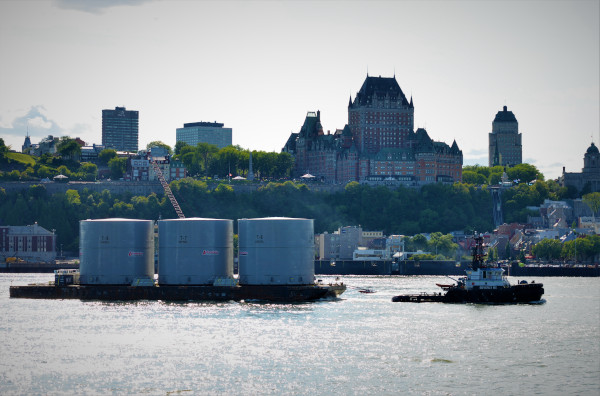
Second: Fuel storage tanks for a Hatch nickel project move by barge along the St. Lawrence River, Québec. Credit: Argus Logistics Consulting Ltd.






.png?ext=.png)





.png?ext=.png)








_1.jpg?ext=.jpg)