Two 260-Ton Units Transported From Jebel Ali for Saudi Port Upgrade
By Malcolm Ramsay
How do you move two 260-ton shiploaders across the Gulf? Martrade and Drewes reveal the planning, coordination and execution behind a challenging transport project from Jebel Ali Freezone, UAE to Jubail, Saudi Arabia.
5-minute read
(Note: this project was carried out prior to the recent outbreak of hostilities in Iran)
The Gulf has seen an explosion of breakbulk activity in recent years, with Saudi Arabia’s Port of Jubail emerging as a critical hub for the movement of ultra-heavy cargo. From gargantuan refineries to sprawling petrochemical plants, the demand for breakbulk components has soared. But with this, so has the complexity of moving cargo across some of the world’s busiest maritime corridors.
Facing this challenge recently, German logistics provider Drewes Group and its partners in the Middle East, the Martrade Group, were tasked with the delivery of two massive shiploaders from Jebel Ali’s Free Zone in the UAE to Jubail, Saudi Arabia.
“Martrade in Dubai served as the single point of coordination between port authorities, the vessel operator, subcontractors and the client, ensuring safe mobilization of extremely large structures within tight operational windows,” Zarir Bhiwandiwalla, head of global logistics at Martrade, told Breakbulk, noting that the project required capability to integrate engineering, marine operations and port handling into one seamless heavy-lift solution.
Collaborative approach
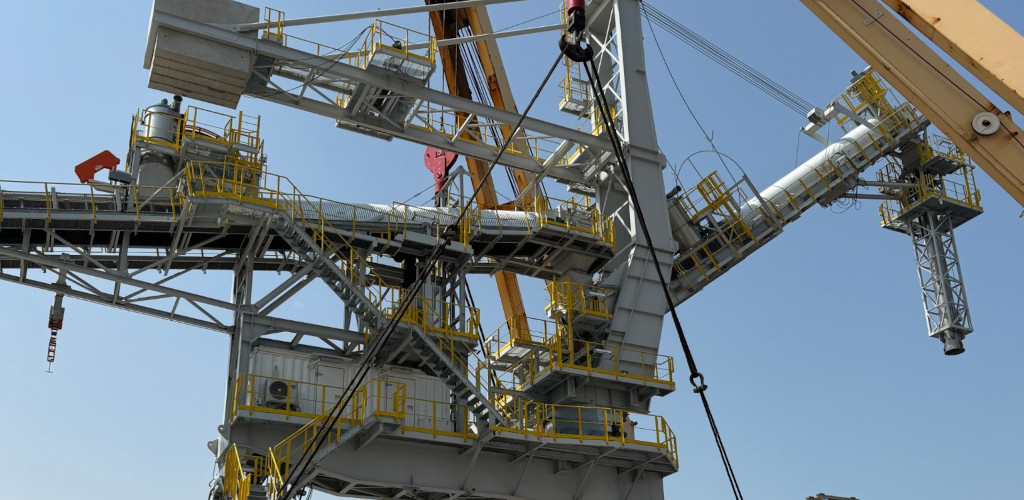
This high-stakes logistics operation was born out of Saudi Arabia’s ambitious plans to upgrade the Port of Jubail, with authorities working to make the port a hub for breakbulk logistics. To achieve this goal, new heavy-lift machinery was required and two giant shiploaders, each stretching nearly 48 meters in length and weighing 260 tons, were ordered from a manufacturer in UAE.
With a combined volume of 83,000 cubic meters, the cargo demanded more than a conventional solution and Drewes was selected to oversee the project thanks to its commitment to a synchronized, engineering-first methodology.
Drewes and Martrade brought in specialist engineering teams experienced in sea-fastening, load-spreading design and structural analysis. The teams worked closely with BBC Chartering, German transport engineering firm GTE and port authorities at both Jebel Ali and Jubail.
“Effective communication was maintained throughout the project through regular operational briefings, toolbox talks, pre-loadout surveys and loading surveys,” Zarir said, noting that this structured coordination ensured alignment at every stage.
Pre-Mobilization: Engineering and Planning
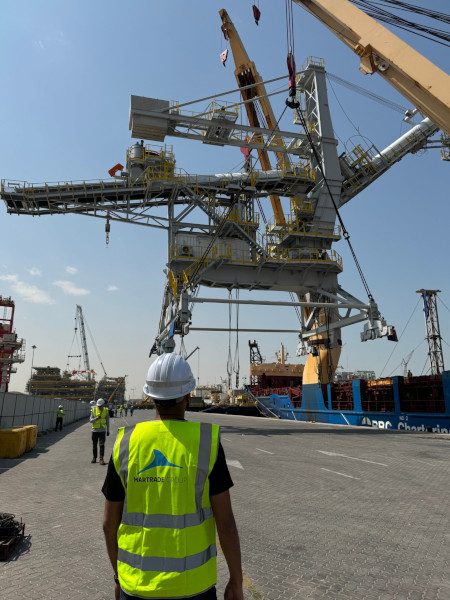 With such ultra-large units involved, the team had to take a unique approach in order to ensure the shiploaders were lifted from shore to vessel in a safe and seamless way and were then suitably secured for the onward voyage by sea.
“Although not remote geographically, the project required managing a controlled operational environment with strict safety, hot-work and port compliance requirements,” Zarir explains.
The first step was to identify the particular risks involved, and to do this Martrade conducted advance engineering studies, looking at the structural strengths of each unit as well as the route from the facility to the vessel.
“General arrangement drawings of both the cargo and the vessel were shared in advance, allowing detailed stowage plans to be developed,” Zarir said. “Deck strength calculations and vessel acceleration analyses were also carried out to determine load distribution and stress points, ensuring stability and structural integrity throughout lifting, sea transport and discharge.”
With the engineering blueprints finalized and risks meticulously mapped, the next phase of the operation involved moving the two colossal shiploaders to the quayside for vessel loading. Measuring 47.76 meters in length, 29.20 meters in width, and 29.90 meters in height, the shiploaders had been assembled on skid beams, a temporary foundation designed to distribute their immense weight and facilitate transfer onto transport platforms.
The team then deployed a fleet of self-propelled modular transporters (SPMTs) configured to provide the necessary load-spreading capacity while maintaining ground pressure well below the five tons per square meter limit imposed by JAFZA’s internal roads.
“The tandem-lifting and welding operations had to be executed within narrow time slots governed by vessel schedules, port regulations, heat conditions and shared berthing availability,” Zarir said, noting that the team introduced a synchronized heavy-lift methodology to streamline operations.
This approach involved creating a repeatable framework that allowed the team to combine custom sea-fastening engineering, load-spreading design, tandem-lift planning, controlled hot-work execution and coordinated SPMT sequencing into a single integrated workflow. It also importantly allowed the shiploaders to be lifted and moved without modifying their structure, due to the reduced risk of deformation.
“The methodology enabled zero cargo damage, zero safety incidents, and safe mobilization,” said Marco Steinforth, project logistics coordinator, Drewes Logistics.
The team worked closely with GTE in refining the load-spreading and sea-fastening designs, ensuring the shiploaders’ structural integrity was maintained throughout the tandem lift and providing an additional layer of technical assurance.
Rapid Loadout
Having moved the shiploaders to the quayside, the next step was to transfer them to the waiting heavy-lift vessel, BBC Mont Blanc. Operated by BBC Chartering, the 13,000-dwt ship was chosen by charterer Drewes for its adaptable cargo capabilities and shallow draft, which ensured compatibility with both Jebel Ali and Jubail’s port depths.
Equipped with two heavy-lift cranes, giving a combined lifting capacity of up to 700 tonnes, the BBC Mont Blanc was more than capable of lifting each unit, while it reinforced deck provided the ideal base for Martrade’s engineered sea-fastening plan.
“At this critical point, Drewes Logistics took command,” Steinforth said, explaining that the BBC Mont Blanc crew then utilized onboard gear to handle the complex loading process with “precision and professionalism”.
Although the journey by sea was only a few hundred miles, the shiploaders' significant weight and high center of gravity required extraordinary attention to detail, and as the window for loading was extremely tight this meant that every crew member was under pressure to perform.
“From lifting, securing and lashing in Jebel Ali to full stevedoring operations in Jubail, every step was meticulously planned and executed,” Steinforth said.
Thanks to careful preparation the first unit was loaded within one day, and the vessel set sail direct to Jubail. The shiploader was discharged at Jubail using vessel cranes directly at the terminal where it was intended for use and the vessel then returned immediately for the second unit, operating as a true “project cargo shuttle.”
“Effective pre-planning, structured surveys and close coordination between all parties enabled the safe and efficient handling of these oversized units within the port environment, despite tight operational windows,” a port spokesperson said.
The shiploaders, now installed at Jubail’s King Fahd Industrial Port, have since entered service and proven critical to the port’s bulk handling capabilities, enabling faster and more efficient loading of materials such as grain, coal and fertilizers — key commodities for Saudi’s growing industrial and agricultural sectors.
Martrade Group and Drewes Logistics will be exhibiting at Breakbulk Europe 2026.






.png?ext=.png)









.png?ext=.png)









_1.jpg?ext=.jpg)