Director Oleg Kozel on Keeping Project Cargo Moving Amid Wartime Disruption
By Simon West
From Issue 3, 2026 of Breakbulk Magazine
(3-minute read)
Project cargo continues to move into and across Ukraine despite the ongoing conflict, but getting heavy and oversized equipment through a disrupted logistics network is no mean feat.
One company operating in this challenging environment is Ukrainian heavy transport specialist Negabarit, a family-owned business established in 2002. Starting out with just two trucks, the company has grown into a major project logistics operator with more than 250 employees and an owned fleet of 195 prime movers and 265 special trailers.
Headquartered in the northwest city of Kovel, close to the Polish border, Negabarit transports breakbulk and project cargo across Ukraine and Europe.
Demand throughout the region is strong, spanning sectors including agriculture, power generation, construction, battery energy storage systems (BESS) and renewable energy, with wind and solar emerging as particularly strong growth areas.
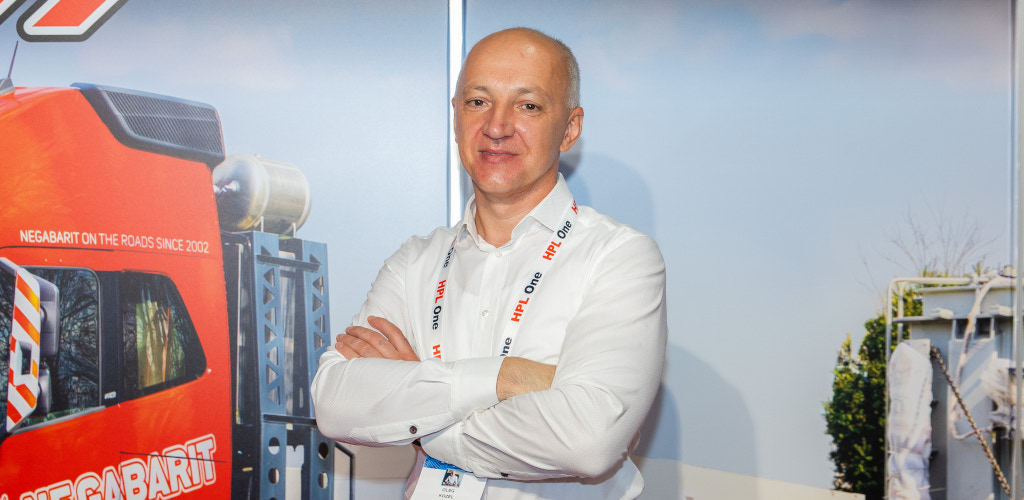
“Negabarit operates state-of-the-art equipment with an average fleet age of three years for trucks, four years for trailers, and just two years for heavy-lift project transport,” said Oleg Kozel, director and owner of Negabarit. “Our heavy-lift capabilities allow us to haul the country’s heaviest components, including power transformers and generators weighing up to 300 tons.”
Operating Through Disruption
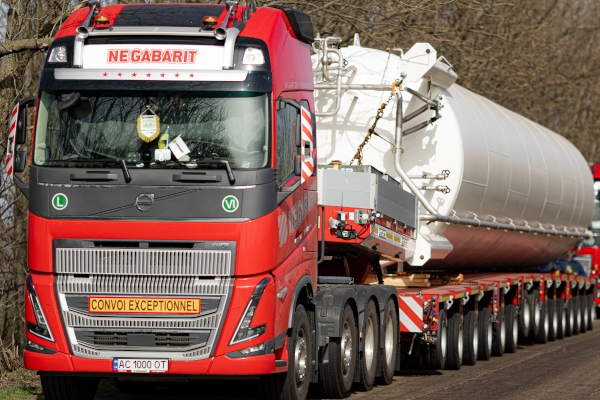 But operating in a growing market does not make the logistics any easier. The war has severely disrupted cargo movements across Ukraine, and with many bridges, roads and other infrastructure damaged or destroyed, particularly in the east, the company has had to devise alternative routes to reach project sites.
That means journeys can often take up to twice as long.
“It does take much more time and effort, but we have no other choice because these goods are needed in those parts of Ukraine. But we rarely refuse a project,” Kozel said.
“If there is a risk (to our drivers), we monitor all available information and maybe stop at a safe parking area before continuing. Sometimes, at the client’s request, we unload goods in a more secure area and complete the final delivery when conditions improve. Insurance is also a challenge, as companies do not cover regions close to the frontline or areas that have suffered direct damage from bombing.”
According to Kozel, the experience in Ukraine has underscored the importance of diversifying transport options. Roads have proved the most flexible solution, allowing heavy-haul operators to avoid difficult or unsafe areas and choose alternative routes.
Rail and sea offer less flexibility when infrastructure or ports are affected.
“If a port closes, the whole system can be disrupted, causing delays to essential deliveries,” Kozel said. “This shows that if there are risks of military action anywhere in Eastern Europe, whether in Ukraine or the Baltic states, strong road infrastructure is essential.”
The Constanta Connection
A further challenge for haulers such as Negabarit is the increasingly complex and high-risk operating environment in the Black Sea. Widely known for bulk commodities such as grain, steel and fertilizers, the waterway is also a vital artery for moving oversized and specialized cargo between Central Asia, the Caucasus and Eastern Europe.
When the Black Sea is disrupted, war-risk costs, inland bottlenecks and complex engineering constraints can quickly turn a maritime issue into costly project delays.
According to Kozel, while Ukraine’s Port of Chornomorsk is technically operating, vessels are often diverted to Romania’s Black Sea port of Constanta. Cargo is then either barged back to Chornomorsk or collected at Constanta and transported by road into Ukraine.
“If the goods are very expensive, the insurance does not cover the possible risks of transporting them by barge to a Ukrainian port. That’s why we pick them up and take them by road to Ukraine and then to their final destination,” Kozel said.
“If there is no long waiting queue at the border, then it takes us two to three days to send a truck to Romania. But we have to be flexible and responsive and provide the best and fastest service we can to the regions where our clients need us.”
Looking ahead, Kozel remains positive about the prospects for Ukraine and its project logistics sector. Significant investment will be needed to restore and modernize the country’s roads and bridges, many of which were already in need of upgrading before the conflict.
He also sees massive potential in green energy, particularly given Ukraine’s size and the scale of infrastructure that will be required to support the sector’s buildout.
Negabarit is preparing for this next phase of development, expanding its capabilities with the latest Goldhofer systems, including a third complete wind transport set that will enable the simultaneous movement of three large wind turbine generators.
In October, the company will also take delivery of Ukraine’s first self-propelled 6-axle Goldhofer Addrive, strengthening its ability to tackle challenging routes and delivery sites.
“We remain deeply confident in the future of Ukraine and its infrastructure restoration,” Kozel said. “By continually investing in world-class, cutting-edge equipment, such as our latest Goldhofer modules, upcoming 6-axle Goldhofer Addrive and specialized turbine sets, we ensure that even the heaviest power generators up to 300 tons, complex BESS energy units and wind components are delivered safely and reliably to wherever they are needed.”
Top photo: Oleg Kozel at Negabarit’s exhibition stand at Breakbulk Europe 2026. Credit: Richard Theemling
Second: A Negabarit truck carrying project cargo in Eastern Europe. Credit: Negabarit




.png?ext=.png)







.png?ext=.png)






_1.jpg?ext=.jpg)