Industry Leaders Eye Rising Heavy-Lift Demand Amid Ongoing Disruption
For Breakbulk's Global Outlook 2027 series, Al Faris, deugro and Combi Lift Projects answer questions on the rising demand for heavy-lift services in the Middle East, the sectors driving opportunity and the challenge of navigating ongoing instability.
From Issue 4, 2026 of Breakbulk Magazine
(5-minute read)
Q: Looking ahead to 2027, how would you describe the business outlook for the Middle East’s breakbulk and project cargo sector?
 Steffen Behrens, CCO, deugro:
The outlook remains overall very positive, but to some degree we also need to be patient. While geopolitical tensions and supply chain disruptions have added complexity, the Middle East continues to offer one of the strongest project pipelines globally. We are now seeing major investments and especially final investment decisions (FIDs) in oil and gas, LNG and petrochemicals. There will certainly be lots of demand for repair jobs and therefore creating sustained demand for heavy-lift and project logistics services. We expect the UAE and Saudi Arabia to remain the primary growth engines, supported by increasing activity in Oman and Qatar as governments continue to invest in energy security and industrial diversification.

Mohammad Jaber, CEO, Combi Lift Projects MEA:
Cautiously bullish, from where we sit as the ones actually moving the cargo. The project pipeline financed over the last few years is now hitting the execution phase, which means more RFQs for engineered transport, not fewer. What’s changed is what clients expect from a logistics partner: route surveys and contingency plans up front, not a quote and a hope. 2027 rewards carriers who can flex when a berth slot or a road permit falls through.
Kieve Pinto, CEO, Al Faris:
 I am optimistic about 2027, but it is a measured optimism, and anyone working in this region has to be honest about the year we have just come through. The conflict and the disruption to shipping through the Strait of Hormuz have delayed project timelines, damaged critical energy assets and made investors more cautious. Yet the fundamentals have not changed. The region’s commitment to energy, infrastructure and industrial development remains, and the project pipeline across the GCC is still very substantial. I expect 2027 to be shaped by two forces: the restart of projects that were paused or slowed, and the repair and reinstatement of existing energy and industrial infrastructure. Both will demand heavier, more complex lifts on tighter schedules. The companies that succeed will be those with the engineering depth, equipment and people to execute reliably when conditions are anything but predictable.
Q; Which sectors or specific projects do you expect to be the biggest drivers of breakbulk and project cargo volumes in the Middle East in 2027?
SB: Energy will remain the dominant driver. In Saudi Arabia, projects linked to Aramco’s gas expansion strategy, including Jafurah and associated processing facilities, will generate significant cargo volumes. In the UAE, ADNOC’s ongoing investments in gas, LNG, carbon capture and offshore developments will continue to create demand for complex logistics solutions. We also see growing momentum in power transmission, grid expansion, battery storage and certain green hydrogen developments, particularly in Saudi Arabia and Oman, where large-scale industrial projects are moving from planning to FID.
MJ: We’re quoting more moves tied to power generation and grid infrastructure, such as transformers, turbines and battery enclosures, rather than traditional oil and gas modules these days. Petrochemical plant expansions and downstream units are still steady work, and Red Sea and Gulf coastal construction keeps adding civil and marine cargo to our books. From a transport-planning point of view, the shift is toward heavier, more awkward single-lift pieces than we were handling five years ago.
KP: Energy will remain the biggest driver, but with a different emphasis than a year ago. Alongside new oil and gas, petrochemical and LNG capacity, including major expansions such as Qatar’s North Field program, I expect a significant volume of work in rehabilitating and reinstating damaged facilities. That often means replacing heavy, long-lead components such as transformers, compressors, reactors and columns under urgent timelines. Power generation and transmission will be a close second, as utilities strengthen grid resilience and continue adding renewable capacity. Saudi Arabia, given the scale of its pipeline, will remain the largest market, while the UAE, Oman and Qatar will each contribute significant activity. I would also highlight infrastructure that improves supply-chain resilience, such as ports, rail and logistics links that offer alternative routes into the region. Across all of these, modular construction will keep pushing component sizes and weights upward, increasing demand for self-propelled modular transporters (SPMTs), high-capacity cranes and engineered lifting solutions.
Q: What do you see as the biggest challenges facing the sector in the Middle East over the coming year?
SB: The biggest challenge is no longer just securing projects but executing them efficiently in an increasingly constrained and difficult environment. We are facing vessel availability issues, skilled labor shortages, pressure on transport infrastructure, rising compliance requirements and continued schedule acceleration by project owners. At the same time, geopolitical developments have increased uncertainty around routing, transit times and project planning. The companies that will succeed are those able to combine in-house engineering expertise, local execution capability and contingency planning rather than relying solely on available transportation capacity.
MJ: Equipment and crew availability, plainly. Heavy-lift vessels, SPMTs, cranes and the rigging teams who know how to use them haven’t grown at the same rate as project awards, so lead times on booking specialized transport are stretching. Add port congestion at key hubs and slower permitting for oversized road convoys, and there’s very little margin left for the kind of quick turnaround clients used to take for granted. Whoever books capacity early wins the year.
KP: The most immediate challenge is operating in an environment where the security and shipping picture can change from week to week. Restricted access through the Strait of Hormuz and pressure on Red Sea routes affect not only when cargo arrives, but where it arrives, and that has knock-on effects for inland transport, permits and site schedules. Insurance, freight and material costs have also risen, putting pressure on project budgets at exactly the moment clients need to move faster. Beyond geopolitics, the structural challenge remains execution capability. Heavy cargo movements depend on route surveys, ground conditions, engineering approvals and coordination between many stakeholders, and none of these can be rushed. Skilled people are another constraint, as experienced engineers, riggers and operators are in short supply across the region. My concern is that urgency must not outpace planning. Early engineering involvement and realistic schedules will matter more than ever.
Q: How is your company responding to the continued uncertainty around the Strait of Hormuz and wider regional shipping and geopolitical risks?
 SB: Over the past year, resilience has become a core element of project logistics planning. We have expanded our contingency planning, assessed alternative corridors through Oman, Saudi Arabia and the UAE east coast, increased our focus on multimodal solutions and strengthened cooperation with clients during the front-end engineering design (FEED) stages of projects. The key lesson from recent disruptions is that logistics must be integrated into project planning much earlier. By combining transport engineering, route studies, marine solutions and alternative routing strategies, we help clients maintain project continuity even under challenging conditions.
MJ: We stopped treating the Strait as a given a while back. Every routing plan we put together now includes a prequalified alternative through Fujairah, Duqm or Jeddah, and we’re holding more buffer in our schedules for clients’ time-critical components. We’ve also started building delay and diversion clauses into our contracts up front rather than negotiating them mid-crisis. Clients increasingly expect their logistics partner to have already gamed this out, not to be scrambling when it happens.
KP: Our approach has been to stay focused on what we can control. In practical terms, that means working with customers much earlier to assess routing options, including cargo discharged at ports outside the Gulf and moved overland. This places heavier demands on road transport, route engineering and cross-border coordination, and it is exactly where a land-side heavy transport and lifting specialist adds value. Our operations across the GCC help us here, because we can assess conditions on the ground in several markets and position equipment and teams where they are needed. We have also strengthened our contingency planning: equipment readiness, alternative route surveys, permit preparation and close communication with clients and authorities, so that if one option closes, another is already engineered. Above all, the safety of our people is non-negotiable. When circumstances change quickly, the ability to adapt the execution plan without compromising safety or reliability is what our customers value most.
Q: What is one development or trend in the Middle East project cargo market that you expect to have a much bigger impact in 2027 than the industry is currently anticipating?
SB: I believe the accelerated development of logistics infrastructure designed to bypass traditional maritime chokepoints will have a bigger impact than many currently expect. Investments in Fujairah, GCC rail connectivity, Oman logistics corridors and east-coast energy export infrastructure are being driven not only by growth but increasingly by resilience and therefore long-term reliability considerations. These developments will gradually reshape cargo flows, project execution strategies and industrial investment decisions across the region. For project logistics providers, this could be as transformative as any individual energy megaproject, but we need to be mindful that there is space for private companies like ourselves who invest in the individual countries and regions.
MJ: In-country localization rules. Governments are pushing harder for fabrication and assembly to happen onshore instead of shipping in finished units. For us that doesn’t mean less cargo; it means a different cargo mix: more inbound components and raw materials, less outbound finished equipment. Carriers still planning their 2027 fleet and route capacity around the old cargo profile are going to find themselves poorly positioned.
KP: I believe the shift toward modularization will have a far bigger impact than many expect, and recent events will accelerate it. When supply routes are uncertain and site labor is under pressure, there is a strong case for doing more fabrication in controlled yards and delivering larger, more complete modules to site. That reduces on-site risk, but it moves complexity into transport and installation. Modules are getting larger and heavier, and the methodology for moving and setting them now has to shape project design from the earliest stages rather than be solved at the end. This will drive demand for SPMTs, hydraulic trailers, gantry systems and integrated lifting solutions, and for the engineers who can plan them. I expect 2027 to reward companies that combine engineering expertise with the equipment capacity to deliver, and that are brought into projects at the concept stage, not just the execution stage.
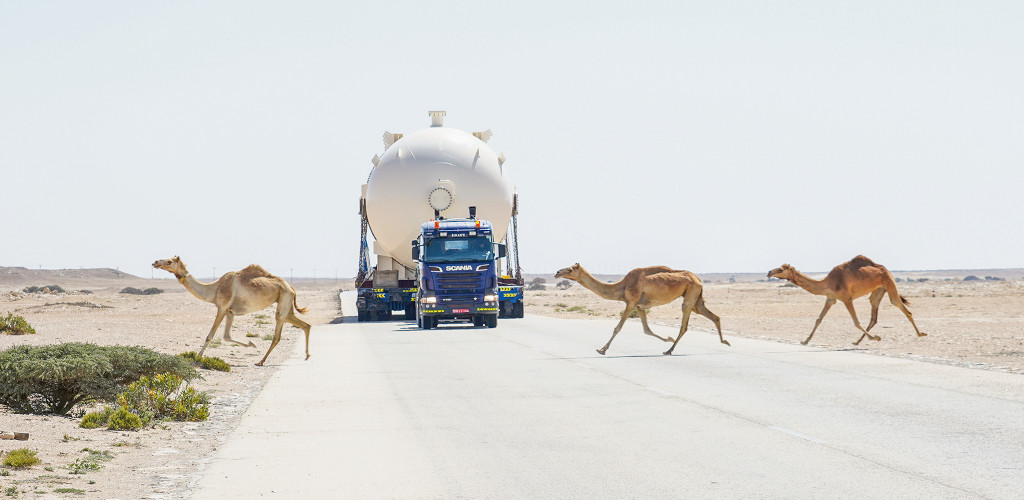
Top photo: deugro transports a 254-ton well fluid slug catcher from Oman to the UAE. Credit: deugro
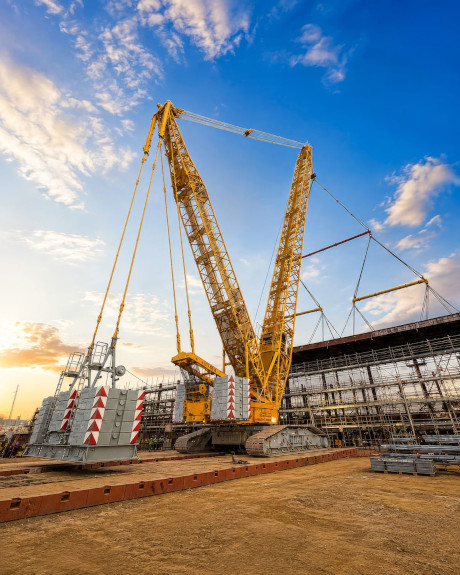
Second: Al Faris deploys its LR1500 crawler crane to lift a 129-ton roof frame in Mussafah, close to Abu Dhabi. Credit: Al Faris