Chris Leach on Air Charter Service’s Global Growth Story — And What Comes Next
_1.jpg)
By Luke King
Air Charter Service’s Chris Leach traces the company’s ascent from basement start-up to global charter player, and looks ahead to what comes next, in this Breakbulk exclusive.
From Issue 1, 2026 of Breakbulk Magazine.
(7-minute read)
“I really didn’t have much choice at all,” said Chris Leach, reflecting on the humble beginnings of Air Charter Service, the now global business he launched with wife Tina in his London basement in 1990. “After all, I was broke and had three mouths to feed, plus a mortgage to pay.”
The then forty-something Brit, son of a pilot, had just returned from a stint in New York, where he’d been working in the U.S. charter aviation market. “We really enjoyed it, but we’re very family-oriented people and my wife was homesick. We also wanted another child, so we decided to come back to England. The next thing I knew, there was a recession and I was out of work. That was my motivation for starting ACS. I had to do something!”
After a failed attempt at operating a franchise for an American firm, the entrepreneurial Leach decided to go back to aviation. “I went down Chris Leach, Air Charter Service to Gatwick airport and spent my time having coffees and lunches with old friends from the days in the charter business with the American airlines and reacquainting myself.”
Next, he armed himself with telex and fax machines and fired off “hundreds” of messages each night to freight forwarders around the world from his home in Kingston. “I sent all these offers, it was a bit like cold calling,” Leach said. “Perhaps I was a bit arrogant, but I just told people: Look, if you need to find an aircraft, I’m an expert, I can find you an airplane.
“And I knew what I was talking about, because I’d loaded them, I’d worked in operations, I’d sold charters as an airline sales guy. Eventually I got a reply from somebody in Singapore, I made 3,000 quid and I could pay the mortgage that month. That’s where it all came from, freight was the start of it all.”
It would be a typically British understatement to say things have since gone well. Today, Air Charter Service operates from around 40 offices worldwide with 800 employees, generating over US$1 billion in annual revenue across cargo charters, private jet operations and commercial airline charters. On average, a flight arranged by ACS took off somewhere around the world every 14 and a half minutes every day in 2025.
Humanitarian Charters
_1.jpg?width=575&height=431) In the early years, ACS’s growth was forged through hands-on, often urgent work, including humanitarian charters, which remain an important business line to this day.
In the early years, ACS’s growth was forged through hands-on, often urgent work, including humanitarian charters, which remain an important business line to this day.
“After Bob Geldof (of Live Aid fame), humanitarian response became almost automatic,” Leach said. When a disaster happened anywhere in the world, the developed economies suddenly had the capacity and the will to mobilize enormous resources for aid.
“I ended up in Khartoum bringing in aid for Sudan, organizing a hodgepodge of aircraft and a Belgian crew that were completely undisciplined. It was wonderful! I had about 11 aircraft on a bad day, 15 aircraft on a good day. Then, we got ships into Port Sudan and a railhead down to Khartoum.
“I set up a distribution network of aircraft flying all over Sudan, and we had a lot of fun, you know. I got these jobs because it was clear the clients had never done anything like it before in their lives, but I had.”
Later, ACS had a ringside seat to witness the boom in Dubai, where Leach cut his teeth in project cargo. He recalls flying alongside legendary oil-well firefighter Red Adair during one of Dubai’s earliest offshore emergencies, using a modified Lockheed Electra to deliver the first 10 to 12 tons of firefighting equipment. What followed was a much larger operation involving five additional civilian Hercules aircraft — a six-plane airlift by the standards of the time.
When Boeing 747 freighters became available, the scale changed dramatically. “I went to Seattle and got trained by Boeing on how to load them,” Leach said. “That immediately knocked the Hercules out of projects, because you could now do 100 tonnes at a time.”
Not every project involved heavy equipment. One memorable assignment saw Leach spending Christmas in Warsaw during the Cold War, organizing the export of high-value pedigree horses. “The Communists were so good at bureaucracy, they kept all the bloodlines going,” he explained.
“So when Poland was a bit broke in the 1970s, they held an auction of the horses. The Indian cavalry bought about 200 or 300 brown ones, and rich Americans snapped up the stallions. I spent the entire Christmas holidays in Warsaw dispatching shipments to India for the cavalry, and the fancy ones to America. That’s a project!”
Asked about his closest brush with disaster, Leach recalls a moment in the mid-1990s when the company came close to missing payroll. With five or six staff on the books, he was counting on a major project involving Antonov An-12 freighters, arranged with an old colleague from Gatwick and lined up out of Moscow.
Focused almost entirely on that deal, Leach admits he neglected other opportunities, leaving him exposed when the project collapsed. “I didn’t have enough money in the company to pay wages,” he said. The lesson, drilled home firmly by Tina, the firm’s finance director as well as his wife, was simple: cash flow.
Tina also put an end to Leach’s brief flirtation with operating his own aircraft in the 1990s. “I bought beaten-up old airplanes and lost money,” he admits. “Tina said, ‘You’re going to bankrupt Air Charter Service.’ So I sold them and never thought about it again.”
As for his proudest moment in business, Leach cites being able to move out of his basement and into rented offices for the first time. “I found three rooms above an old shop in Kingston for £50 a week. And although the floors weren’t level, I really started to feel like I had a proper company.”
Can-Do Attitude
Leach, who splits his time between his homes in London and the New Forest in southern England, says he’s made a conscious effort to pass on his can-do attitude to his employees.
“We’ve got hundreds of young people working for us around the world, and I encourage them to be proactive. In sales, there are hunters and farmers, and we need both. But if there’s a secret to how we’ve grown, it’s probably that I trained as a teacher before any of this.
“Training has always been central. Not just telling someone what to do, but building clear methods, writing things down and properly teaching charter aviation, sales and compliance. As we grew, so did our systems, and we became known in the industry for developing people. ACS grows people.”
For Leach, that focus on people feeds directly into trust. He describes himself as straightforward — and expects the same from his teams. “We always pay. We don’t go broke,” he said. “People are trained not just in aviation and sales, but to be honest and direct. That builds trust, and trust builds a business."
He bristles at the suggestion that ACS is merely a middleman. “We’re an intellectual value-added business, like accountants or lawyers. What’s in our heads is what matters. We’re not just taking a margin, we’re adding value to the supply chain.”
That value, he argues, comes from deep market knowledge. “There are hundreds of aircraft types, thousands of operators and huge differences in quality and reliability. We deal with all of it. We know this stuff.” Airlines, he adds, have increasingly come to recognize that expertise, something that wasn’t always the case.
Looking ahead, Leach plans yet more growth. ACS currently operates around 40 offices, but internal analysis suggests demand in as many as 70 to 80 cities worldwide. “We’ve got a lot of work to do.” Project cargo, meanwhile, remains central to both the business and Leach himself.
“Project cargo has been in my DNA from the start. The Sudan airlift was a project. The oil fire was a project. Building Dubai was a project. I love projects. I’d rather do this than work and the great thing is, I’ve never felt like I had to.”
Middle East Expansion
.jpg) Having already traced the company’s origins with its founder, a visit to the UAE ahead of Breakbulk Middle East offered a timely opportunity to see how Leach’s blueprint is playing out in one of ACS’s most dynamic regions.
Having already traced the company’s origins with its founder, a visit to the UAE ahead of Breakbulk Middle East offered a timely opportunity to see how Leach’s blueprint is playing out in one of ACS’s most dynamic regions.
Walking into the company’s Dubai office, you immediately sense the energy of a business in expansion mode. Elie Hanna, who took over as CEO of the Middle East region in March 2024, is navigating what he calls “exciting times” as ACS shifts from its traditional single-office strategy to an aggressive regional growth plan.
“For the past, let’s say, 18 years or so, Air Charter Service was focused mainly on one office in the region, Dubai,” Hanna said. “But now the vision has changed. We realize that more offices, more people on ground, more local connections and more local knowledge is key to market success.”
The company opened its first Saudi Arabian office in Riyadh in August 2024, staffing it with four employees, including ACS’s first Saudi national. Qatar is next on the agenda, while the long-term plan calls for at least five Middle East offices within five years.
The Saudi expansion illustrates the thinking behind this new regional strategy. Having a physical presence doesn’t merely improve customer relationships, it fundamentally changes what business ACS can pursue.
“Before, we used to get business from third parties who won a tender and then went out looking for good suppliers to be able to provide the airplanes, and you might only get a small part of the contract,” Hanna said. “Now we are focused on getting more exclusive business, building proper relationships and getting closer to our customers, whether it’s the private jet division, commercial charter or cargo charters.”
According to Hanna, Saudi Arabia’s transformation under Crown Prince Mohammed bin Salman has created new opportunities for companies willing to establish local operations. While relationships remain important in doing business, he said the process has become clearer and more structured. “The concept of winning business has changed,” he said. “It’s no longer based purely on who you know. It’s now driven by formal tenders published to the market, the quality of documentation and what you can offer.”
This more transparent procurement approach often requires companies to hold Saudi licenses and maintain a physical presence in the kingdom. One high-profile example is the Dakar Rally, an event requiring cargo aircraft, commercial air movements and helicopters, which ACS has supported for years through third parties but can now tender for directly.
Diverse Portfolio, Urgent Timelines
While private jets remain the Dubai office’s largest division, driven by the UAE’s emergence as a safe haven for high-net-worth individuals post-COVID, cargo operations are expanding rapidly and Hanna’s team has simultaneously expanded the customer base beyond traditional freight forwarders to include high-net-worth individuals and royal family members.
The operational reality in the Middle East differs sharply from Europe or the U.S. Short-notice requirements are the norm rather than the exception, and every cross-border flight involves securing permits, even within the GCC, where open skies agreements remain elusive despite talk of integration.
“Pre-planning is not one of the region’s best attributes,” Hanna jokes. “The nature of our business is last-minute, short-notice, intense conversations. There are plenty of late evenings, issues with permits and flight approvals.”
He shares a running joke in the aviation industry about “Peter,” a 29-year-old man who looks 65 because of the business. But Hanna clearly thrives on the pressure. “It’s the joy of having the challenge and finding the solution,” he said.
Fortunately, the regional infrastructure supports the demands of the trade. Middle East airports are “well equipped to handle huge aircraft” with an abundant workforce, which is in stark contrast to Europe, where slot restrictions, noise limitations and labor shortages create bottlenecks. The persistent challenge is permits, rather than operational capacity.
Regional Hub Status
 Dubai’s evolution into the business hub for aviation has been striking, according to Hanna, who has watched the transformation during his 15 years with the company.
“The more Dubai grows, the more operators like to come and create relationships here,” he observes. “Dubai has outgrown Geneva, which used to be the business hub of aviation in Europe. Now when you go to Geneva, you see fewer and fewer airplanes and fewer people.”
This shift has elevated the Dubai office to one of ACS’s top-performing operations globally in terms of flights, revenue and market exposure. It currently employs 40 people, including 28 brokers, with an additional four in the new Riyadh location.
The regional expansion strategy reflects broader ambitions. Egypt represents another growth opportunity, while Hanna sees long-term potential in Syria and Lebanon once reconstruction efforts begin in earnest. “After a long-lasting war in the region, these markets will have a lot of development,” he said. “That will require a lot of cargo movement, a lot of support.”
Throughout our conversation, it’s clear that while day-to-day operations have been delegated to regional leaders, founder Chris Leach remains intimately involved in major strategic decisions. “For things like expansion, Chris has the final say,” Hanna confirms. “He’ll take the big decisions: expansion, assigning key employees in certain locations, which markets to focus on and to grow — he still enjoys that part of the business.”
For Hanna and his growing Middle East team, the challenge ahead is clear: transform ACS’s presence from a single Dubai beachhead into a truly regional network while maintaining the service quality and supplier relationships that have built the company’s reputation over more than three decades in the market.
Back in London, Leach is characteristically bullish about the future. With ambitious targets to nearly double the office count and push revenue toward US$3 billion, the man who started out cold-calling from his basement shows no signs of slowing down. “We’re only half done,” he says.
Air Charter Service will be exhibiting at Breakbulk Middle East 2026.
Top photo: Chris Leach in his UK office. Credit: Chris Leach
Second: The early days of ACS in Chris Leach’s basement. Credit: Chris Leach
Third: Elie Hanna, Air Charter Service. Credit: ACS
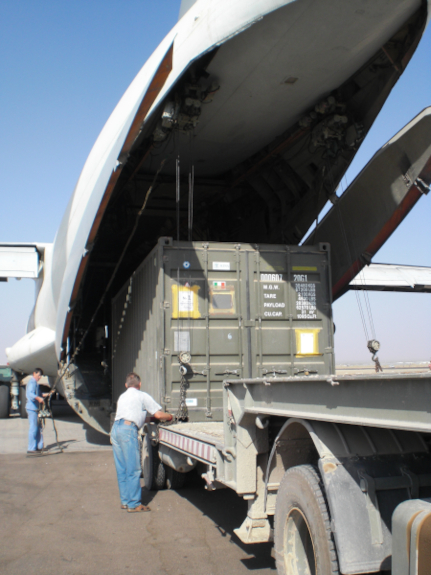
Fourth: ACS manages the loading of a power generator in the Middle East. Credit: ACS





.png?ext=.png)









.png?ext=.png)









_1.jpg?ext=.jpg)