Project Cargo Profits as European Spending Surge Upgrades Region’s Infrastructure
By Luke King
Companies including Trans Global Projects, Siemens Energy, Saipem and AProjects reveal how Europe’s defense spending surge is upgrading the infrastructure that project cargo depends on.
From Issue 2, 2026 of Breakbulk Magazine.
(7-minute read)
Europe’s defense spending surge is becoming one of the most significant drivers of heavy transport infrastructure investment the continent has seen in decades. As governments pour money into military mobility — the ability to move troops and equipment rapidly across borders — the roads, bridges, rail links and ports being upgraded are the same ones that project cargo specialists rely on every day. The scale of the investment is considerable.
The EU’s Connecting Europe Facility has already allocated €1.74 billion for military mobility in the 2021-2027 budget period, co-funding 95 dual-use infrastructure projects across 21 member states, while the European Commission has proposed a tenfold increase — €17 billion — for the 2028-2034 period. NATO’s Security Investment Programme contributed a further €1.72 billion in 2025 alone.
At the heart of the Military Mobility Package are four priority military corridors and some 500 hotspot projects aimed at removing physical bottlenecks: weak bridges, narrow tunnels and ports that cannot handle roll-on, roll-off (RoRo) military loads at scale. The connectivity gap between the Baltic States and Poland is among the most striking examples of the problem: a single main road links Poland and Lithuania, while incompatible rail gauges cause long delays at the border.
Most EU roads carry a 40-tonne weight limit, yet modern battle tanks weigh between 55 and 70 tonnes, a mismatch that illustrates just how far civilian infrastructure standards have drifted from military requirements.
“Dual-use infrastructure means building ports and transport links to military axle-load and weight standards,” says Andreas Menzel, managing director Northern Europe at Trans Global Projects. “Those standards are far closer to project cargo requirements than to normal commercial freight, which is why these investments matter directly for heavy logistics.”
Germany: The Transit Backbone
 Germany sits at the center of the military mobility map, functioning as the primary transit corridor between Western Europe and NATO’s eastern flank, a role that is driving targeted investment in port and rail infrastructure already beginning to benefit commercial heavy transport.
At Bremerhaven, funding linked to military mobility has been directed at reinforcing quays, strengthening port surfaces, upgrading rail infrastructure and improving internal access routes. Once in place, those same reinforced surfaces and load-rated quays become permanently available for project cargo.
“When a quay or yard is built to carry military axle loads, project cargo benefits immediately,” Menzel says. “It reduces the need for temporary load-spreading, lowers operational risk and makes heavy lifts more repeatable.”
On the rail side, Germany’s pool of wagons suitable for military transport has fallen from over 1,000 in 1990 to just a few hundred, a decline that reflects decades of underinvestment. Military mobility requirements are now pushing that in reverse. “Military mobility pushes rail systems to accommodate very heavy units and long formations,” Menzel adds. “For project logistics, that can be the difference between rail being a theoretical option and a practical one.”
Ruediger Fromm, logistics business partner for wind power at Siemens Energy, says investment is overdue. “From a shipper’s perspective, infrastructure upgrades in many European countries are needed, as resilient heavy-cargo infrastructure is a prerequisite for industrial competitiveness and economic growth,” he says. “The main challenge today and for the foreseeable future remains identifying and securing suitable transport routes amid regulatory, technical and regional constraints.”
Poland: The Eastern Flank Corridor
No country in Europe has felt the strategic urgency of military mobility more acutely than Poland. Since Russia’s full-scale invasion of Ukraine, Poland has become the primary logistical hub for NATO’s eastern flank, and the infrastructure investments flowing in reflect that reality directly.
Łukasz Chwalczuk, president of the Polish Abnormal Road Transport Association (OSPTN), ESTA Europe board member and managing partner at law firm iuridica, describes a wave of defense-linked projects already benefiting civilian heavy transport. In early 2026, an agreement was finalized to reconstruct the Kwiatkowski Route serving the Port of Gdynia, a critical NATO equipment node, after years of structural degradation and weight restrictions.
The Polish Ministry of National Defence has simultaneously prioritized the so-called Red Road, a direct connection from Gdynia’s port terminals to the S7 expressway, with around €1 billion secured for the project.
“These investments are a gamechanger for civilian heavy transport,” Chwalczuk says. “They will eliminate port-entry bottlenecks and provide a durable, high-capacity corridor for oversized project cargo, allowing heavy road transport to bypass aging city infrastructure entirely.”
Rail investment in Poland is similarly substantial. CEF Military Mobility funds are being directed at rebuilding RoRo ramps, expanding rail siding layouts and, critically, reinforcing the load-bearing capacity of bridges, culverts and viaducts across southern and eastern Poland.
Military requirements to transport 60-tonne Abrams and K2 tanks are forcing upgrades to structures that had long constrained civilian freight. “The military is no longer building isolated infrastructure solely for its own use,” Chwalczuk notes. “Defense spending is being integrated into the public network, making the military a powerful financial sponsor for civilian infrastructure.”
However, Chwalczuk is direct about the gap between investment plans and operational reality. “From a project cargo perspective, these improvements are not yet felt in day-to-day operations,” he says. “These are long-term investments, and we expect to see their real impact only in the coming years.”
He also flags a deeper structural problem: Poland’s permit system remains heavily paper-based, each application reviewed from scratch regardless of precedent, and legal appeals for refusals take around two years to resolve. Infrastructure investment, he argues, must be matched by administrative reform.
Looking further ahead, Chwalczuk sees the investment cycle continuing regardless of how the war in Ukraine resolves. The eventual reconstruction of Ukraine will generate an enormous volume of oversized cargo movements, much of it transiting through Poland, and the corridors being built today for military mobility will serve that demand just as directly.
“I expect this to be a long-term trend,” he says. “The reconstruction of Ukraine will require a massive volume of oversized cargo deliveries, making these upgrades essential for the long haul.”
Finland: The NATO Newcomer
Finland’s accession to NATO has redrawn the strategic map of northern European logistics. With the EU’s longest border with Russia and a geography that makes reliable north-south and east-west connectivity essential, Finland has moved rapidly to the center of military mobility planning.
The Finnish government announced in April 2026 a first tranche of €112 million for military mobility projects, including planning for a European rail gauge link between Tornio and Kemi, bridge strengthening and critical road improvements, connecting with the Joint Nordic Strategy for Transport System Preparedness published in March 2026.
The Port of Pori illustrates how CEF funding is being deployed at project level. A €3.15 million EU contribution has funded a new fixed RoRo ramp and expanded cargo yard at Mäntyluoto Harbour. The port’s proximity to military bases gives the upgrades clear strategic value; its enhanced RoRo and heavy cargo capacity now serves both commercial and defense purposes. In April and May 2025, the facilities proved their worth when military vehicles were transported through during joint exercises.
 Jussi Heinonen, managing director Finland at Trans Global Projects, describes a shift in the nature of demand since NATO accession. “Since Finland joined NATO, we’ve seen a clearer focus on defense-related logistics planning rather than an immediate spike in cargo volumes,” he says. “The discussions are increasingly about feasibility, routing and infrastructure capability for heavy and oversized units.”
Heinonen points to the structural dual-use logic that makes military investment relevant for commercial project cargo. “Infrastructure upgrades linked to defense spending are making a tangible difference. When roads, bridges, rail or ports are designed to handle military axle loads and weight classes, civilian project cargo benefits automatically.”
The main constraints, he adds, are often not on primary corridors but on secondary links: access roads, weight limits and turning radii that still dictate transport strategy for the heaviest loads, compounded by climate conditions and long distances.
It is on that last point that Finland brings something distinctive to the broader European conversation. Detailed route surveys, conservative engineering assumptions, winter-adapted transport practices and close coordination with authorities have long been standard practice in Finnish heavy cargo operations.
“These are capabilities that are now becoming more relevant across Europe,” Heinonen says, and as the continent focuses on military readiness and logistics resilience, the Finnish approach is increasingly being looked to as a model.
Türkiye: The Strategic Bridge
Türkiye’s role in European military mobility is distinctive. Though not fully integrated into EU military frameworks, it nonetheless occupies a critical position at the junction of Europe, the Black Sea, the Caucasus, the Middle East and Central Asia.
Uğur Çelikoğlu, a logistics expert in Türkiye, describes an infrastructure model that embeds military standards into civilian networks. “Türkiye is not building separate defense logistics networks,” he says. “Instead, it is quietly militarizing its civilian infrastructure standards.”
Under the 2053 Transport and Logistics Master Plan, motorway expansion has been designed with axle loads, gradients and bridge capacities compatible with heavy military equipment. Rail is receiving over 50% of transport investment allocations through the mid-2030s, with port capacity expansion at Mersin, Ambarlı, İskenderun and the planned Çandarlı carrying strong dual-use relevance.
For project cargo, the results are already tangible: “Türkiye’s road network increasingly supports high gross vehicle weights and oversized cargo, reducing route surveys and escort constraints,” Çelikoğlu says. Mersin and Ambarlı have emerged as regional project cargo gateways rather than purely container-focused facilities.
Cyril Guth, a director at Antwerp-based AProjects, sees Türkiye’s value in broader strategic terms. “Türkiye is not just a European logistics market, it is a strategic bridge between Europe, the Black Sea, the Caucasus, the Middle East and Central Asia,” he says.
“From a project cargo perspective, its relevance lies in ports, industrial capacity and regional connectivity.” That geography, he adds, means planning for movements through or into Türkiye requires a different reading of infrastructure, permissions and geopolitical exposure than anywhere else in the region.
New Platform for Defense Logistics
One indicator of how seriously the project cargo industry is taking the defense opportunity is the emergence of dedicated networking platforms to serve it. AProjects is launching DLOP — the Defense Logistics Online Platform — a pooled competence and procurement resource connecting freight forwarders, equipment suppliers and specialist operators focused on military logistics work.
“Everyone is working on their own corner right now,” says Guth. “We want to create a wider platform where contacts, capabilities and equipment can be shared, including a procurement module specialized in military logistics, because it doesn’t exist today.” The network will also give regional agents registered with national ministries of defense access to a broader network of suppliers and counterparties.
Guth takes a measured view of the pace of change. Part of the evolution in project cargo networks, he argues, is already underway, driven by a convergence of forces: Energy projects, geopolitical tensions, shifting trade flows and industrial investment are all prompting ports to reposition, new vessels to be ordered and routes to be reassessed. Defense spending adds another layer to a process already in motion.
The Regulatory Gap
For all the capital flowing into physical infrastructure, industry stakeholders are consistent on one point: Bricks and steel alone will not solve Europe’s military mobility problem.
According to the European Association of Abnormal Road Transport and Mobile Cranes (ESTA), the movement of heavy military equipment across Europe still relies on civil transport frameworks that are fragmented, inconsistent and slow. Permit requirements for oversized loads vary significantly between member states, and ESTA estimates permit-related administration costs the sector around €500 million annually.
“Fragmentation of national rules for oversized and overweight transport constitutes one of the core bottlenecks for military mobility by road,” the association noted in a position paper.
The EU’s Military Mobility Package proposes standardized procedures, digital permitting and a maximum three-day approval window for cross-border movements, all of which Chwalczuk broadly welcomes. But, he cautions, without genuine digitalization and reform of a permit appeals process that currently takes around two years to resolve, their impact will be limited.
For logistics providers, the administrative layer is a daily reality. “Administrative and permitting processes, especially in Western markets, can add layers of complexity that impact timelines,” says Guth. “The link between defense investment and tangible improvement on the ground is real, but still maturing."
The prize, for military and civilian project cargo alike, is the same: A network strong enough to move the heaviest equipment quickly, reliably and across borders without bureaucratic delay. Europe is investing at a pace not seen in decades. Whether the regulatory environment moves fast enough to match it remains the open question.
How defense-driven investment is transforming the region’s logistics networks will be the focus of a panel discussion at Breakbulk Europe 2026. Will Demand for Military Readiness Save Europe's Aging Infrastructure? is happening on the Breakbulk Live Stage on Wednesday, 17 June from 11:40am - 12:25pm.
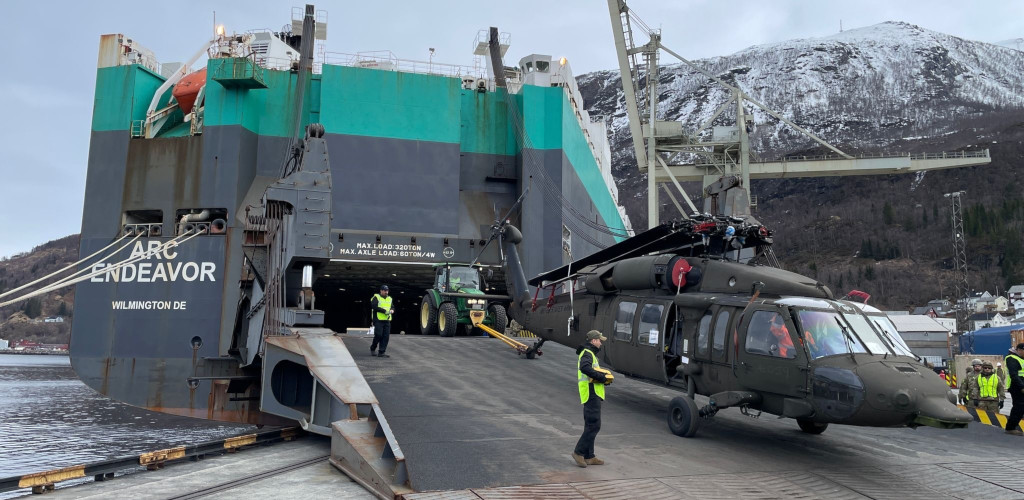
Top photo: American Roll-On Roll-Off Carrier (ARC) offloads NATO military hardware in Narvik, Norway. Credit: ARC
Second: Andreas Menzel, Trans Global Projects. Credit: TGP
Third: Jussi Heinonen, Trans Global Projects. Credit: TGP






.png?ext=.png)








.png?ext=.png)









_1.jpg?ext=.jpg)