Investments Critical to Sustain Waterway’s Market Position
By Donald Horne
Showing its age under the strain of ever-larger vessels, the Panama Canal is set for a US$8.5 billion overhaul aimed at boosting capacity and shoring up resilience to climate change.
From Issue 1, 2026 of Breakbulk Magazine.
(5-minute read)
There are frequent headlines proposing alternatives to the Panama Canal for capturing Atlantic-to-Pacific global trade but, despite the noise, none offer the same combination: a fully integrated maritime, port, logistics and free zone ecosystem in one place.
When it first opened in 1914, the Panama Canal was a technological marvel that allowed U.S. battleships to pass from the Atlantic to the Pacific without having to take the long, perilous trip around the tip of South America. Today, the canal is showing its age, and in need of an update to accommodate the ever-increasing size of cargo carriers and tankers. Panama Canal Authority (PCA) administrators know they must continue to invest and upgrade, or risk trade going elsewhere.
The plan is to pump US$8.5 billion into the canal to boost capacity and mitigate the effects of climate change. According to Panama Canal administrator Ricaurte Vásquez: “We are working hard to ensure that environmental and climate conditions do not disrupt operations.”
In a recent interview at the Houston International Maritime Conference, he added that a new gas pipeline and the construction of two ports at either end of the canal are part of a broader effort to diversify operations and strengthen reliability. “We are guaranteeing that the Panama Canal remains committed to diversification with investments that provide operational assurance for the industry,” Vásquez said.
With liquefied petroleum gas (LPG) volumes projected to rise over the next decade, Vásquez warned that “almost everything that comes from the U.S. going to Asia goes through the Panama Canal.” If capacity is not expanded, he cautioned, “we’re going to lose that part of the market share.”
China in Play
The U.S. is not the only party watching the construction of the new ports at the canal. Chinese and other Asian operators, including COSCO Shipping Ports and CK Hutchison Holdings, are expected to show interest once Panama opens formal bidding.
President Donald Trump has claimed that Beijing already exerts influence over the waterway since Hong Kong–based CK Hutchison Holdings operates its two main terminals — Cristobal and Balboa. While the firm agreed earlier this year to transfer control of those terminals to a BlackRock-led consortium, the deal has not been finalized and has reportedly raised concerns in China.
The investment in the new proposed terminals aims to increase container transshipment capacity by five million TEUs (20-foot container units) per year, an expansion viewed as essential because the system is already operating near its limit.
To advance the project, Panama has begun the initial consultation phase and preparatory work. As part of this process, a market and feasibility study will be conducted for both terminals, with representatives from APM Terminals, Cosco Shipping Ports, CMA Terminals, DP World, Hanseatic Global Terminals, MOL, PSA International, SSA Marine–Grupo Carrix and Terminal Investment Limited (MSC) participating, as well as representatives from CMA CGM, ONE, Evergreen, Hapag-Lloyd, HMM, Maersk, OOCL, COSCO, Yang Ming, Port of Houston and ZIM.
Following this, a general project plan will be put into place along with a special process to select a concessionaire, which is expected to wrap up by the end of 2026. Construction work on the terminals is projected to generate approximately 8,100 jobs, and 9,000 jobs once operations commence.
Dropping Water Levels
.jpeg) A Northwestern University climate study warns that decreasing water levels and severe drought now pose a real threat to trade through the Panama Canal.
A Northwestern University climate study warns that decreasing water levels and severe drought now pose a real threat to trade through the Panama Canal.
Ships that use the canal rely on a reservoir of fresh water that is high enough to allow them to pass through, but droughts can slow the rate of passage, and that is “absolutely” having an effect on bulk traffic, says Rosangela Díaz Malavé, co-owner and commercial director of Nakama Worldwide Solutions, a Panama-based forwarder and member of The Heavy Lift Group (THLG), Global Project Logistics Network (GPLN) and Cross Ocean networks.
“There have been clear difficulties in the flow of bulk traffic due to lower water levels in the Panama Canal,” says Malavé. “Public data from the PCA shows that drought conditions have led to draft restrictions, reduced daily transit slots and lower bulker throughput.”
These limitations force vessels to carry less cargo, increase costs and create delays, with some bulk trades even rerouting and facing significantly longer sailing distances.
From a logistics perspective, this directly affects operations by increasing price volatility, reducing schedule reliability and requiring more flexible planning for customers. “For companies like us, the situation reinforces the need to anticipate disruptions, strengthen relationships with carriers and monitor the canal’s ongoing water-management investments,” says Malavé.
“In my opinion, lower water levels have had a material impact on bulk cargo flow, and while recovery efforts are underway, the risk remains,” Malavé said. “Building resilience and planning for future drought-related constraints are essential for maintaining service stability and protecting long-term competitiveness.”
Race Against Time
“The Panamanian government is working against time to open two new port facility tenders,” said Roland Alvarez Viera, president of Panamanian forwarder Up Cargo Logistics. “One for the construction of new ports at the Pacific side and the other at the Atlantic side of the canal, which will increase all multimodal services requested by international trade.”
Approximately 6% of all international trade passes through the canal, underscoring its role as one of the world’s most important maritime corridors. Panama’s President Mulino recently met with a number of major carriers at their offices in Europe to determine the best solutions for the users of the canal.
“We expect by the first half of the year, the government will have set all requirements for the tenders,” Viera said.
Panama has a cluster of five major international ports — Manzanillo, Cristobal, Colon Container Terminal, Balboa and Rodman, forming one of the most capable maritime networks in the region. These facilities handle container, bulk, breakbulk and roll-on, roll-off (roro) cargo, serving as key transshipment hubs for trade moving between the Americas and global markets.
The option of having two more ports in this cluster will represent “faster transit time with less supply chain disruptions,” says Viera.
The PCA is also developing a project to draw additional water from the Río Indio basin to help maintain supply for more than 2.5 million Panamanians and support canal operations. Disruptions made by El Niño and La Niña in the past reduced the number of vessels through the canal, from 36 to 18 transits per day.
Today, Viera said, Panama functions as a major logistics hub, with the canal handling close to 15,000 transits per year and connecting 180 routes in 170 countries, and the country’s port terminals moving close to 9.57 million TEUs annually.
Upgrades Are Crucial
The upgrades to the ports and canal to maintain and increase bulk traffic are crucial, says Malavé, as the last major overhaul was in 2016 with the opening of the new locks, Agua Clara on the Atlantic and Cocolí on the Pacific.
“However, port infrastructure did not expand at the same pace,” Malavé said. “Speaking from experience in the logistics sector, and from what we observe daily in Panama and across the region, demand patterns have changed dramatically. Today, shippers and importers expect faster turnaround times, higher reliability and the ability to reroute cargo efficiently when global disruptions arise.”
It was only recently that President José Raúl Mulino launched a tender focused on increasing port capacity, modernizing equipment, expanding dredging efforts and developing two new ports: one on the Pacific side (Corozal) and another on the Atlantic side (Margarita).
“These initiatives directly strengthen Panama’s value proposition as a regional logistics hub,” Malavé said. “Such upgrades lead to shorter vessel wait times, improved draft availability, and more efficient cargo handling, critical elements for bulk operations where time and volume have a direct impact on costs.”
For canal operations, maintaining and enhancing water-management systems and transit capacity remains essential.
“Carriers rely heavily on stable draft levels and predictable scheduling, and any restrictions immediately affect global supply chains,” she said. “Continued improvements, especially in water sustainability and operational efficiency, are key to ensuring Panama remains a competitive, reliable, and strategic corridor for global trade.”
Keeping Trade Moving
From a logistics perspective, the Panama Canal is a critical link in global trade. “It’s the route that keeps a huge part of trade moving smoothly between the Atlantic and Pacific,” Malavé said. “For companies like ours, it really makes a difference as the canal gives us fast, cost-efficient connections, which is especially important for cargo where time, draft and cost per ton matter so much.”
She stresses that the canal is far more than an optional route — it is a core link in the global supply chain. “It handles a meaningful share of world trade, cuts thousands of miles from shipping routes and supports a huge variety of cargo types,” Malavé said. “When the canal works well, global logistics flows more efficiently; when it struggles, the impact is worldwide.”
And yes, there are frequent conversations about alternatives: the dry canal idea in Mexico, logistics corridors in Nicaragua and other regional projects. They might take on some specific segments or complement certain routes, but none of them offer what the Panama Canal provides: a real maritime shortcut.
“Panama’s strength goes far beyond geography,” Malavé said. “It’s about experience, infrastructure, and reliability.”
Keeping project cargo moving amid trade lane closure will be a key talking point during a main stage panel session at Breakbulk Middle East. Geopolitics in Motion: Security Risks and Contingency Planning, moderated by Qamar Energy's Robin Mills, will take place on Wednesday, Feb. 4 from 11:30am-12:15pm.
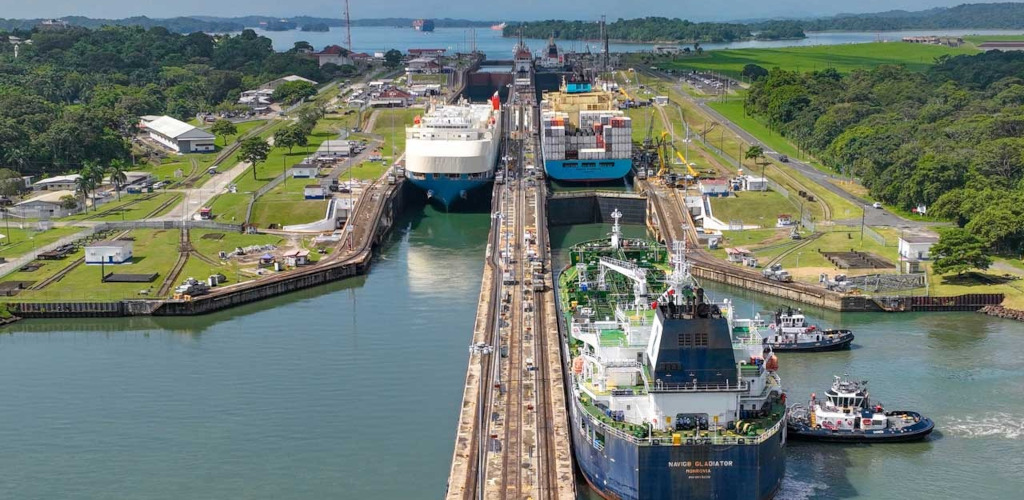
Top photo: Vessels laden with cargo enter the Panama Canal’s locks. Credit: Panama Canal Authority
Second: Rosangela Diaz Malavé, Nakama Worldwide Solutions. Credit: Nakama




.png?ext=.png)






.png?ext=.png)






_1.jpg?ext=.jpg)