Why Container Ships Are Carrying More Project Cargo Than Ever Before
By Amy McLellan
Did you know that 20% of project cargo is now transported by container vessels? Industry leaders including MSC, CMA CGM, Maersk and Protranser challenge long-held ideas about what can — and can't — fit in the box.
From Issue 1, 2026 of Breakbulk Magazine
(6-minute read)
Container shipping is the backbone of global trade. Every year, around 250 million boxes move across the world’s oceans, carrying more than US$7 trillion worth of goods on over 2,000 regularly scheduled services, most of them weekly.
These highly optimized networks connect virtually every trading nation on earth, keeping commerce flowing despite mounting pressure from tariffs, trade disputes, geopolitical tensions, cyber risks and tightening environmental regulation.
In recent months, the sector has again been under close scrutiny. In December, the Drewry World Container Index (WCI) rose 2% to US$1,957 per 40-foot container, supported by seasonal strength on Asia–Europe trade lanes ahead of the Lunar New Year in February 2026.
At the same time, industry watchers are monitoring political developments closely. A return to shipping through the Suez Canal could release an estimated 6–8% of global container capacity, around 2 million twenty-foot equivalent unit (TEU), currently absorbed by longer voyages around Africa to avoid the Red Sea conflict zone.
What moves inside these millions of containers is the fabric of modern life: consumer goods, electronics, automotive parts, machinery, chemicals and foodstuffs. But increasingly, container ships are also carrying something else — project cargo, including oversized, heavy and high-value components traditionally associated with breakbulk or heavy-lift vessels.
According to Rafael Vicens, head of Maersk Project Logistics IMEA, globally around 20% of project cargo is currently moved by container ship, and those volumes are trending up.
.jpg) Ben Collins, project cargo director at MSC, agrees. “Every year we see new shippers exploring this option,” he said. “In our experience, customers are increasingly attracted to using container ships to move cargo safely, predictably and efficiently.”
Ben Collins, project cargo director at MSC, agrees. “Every year we see new shippers exploring this option,” he said. “In our experience, customers are increasingly attracted to using container ships to move cargo safely, predictably and efficiently.”
Both agree that there’s a natural limit to what can be shipped via container ship. Vicens, for example, doesn’t expect it to reach 50% of the market, but says there’s plenty of scope to expand current volumes.
“For some projects, the really huge or the really heavy, there will always be a need for specialist breakbulk equipment and carriers,” Collins said. “But we’re accommodating ever larger, heavier pieces on our vessels, and the window for what can fit is constantly growing.” That view is echoed across the liner industry. A spokesperson for CMA CGM says there has been a strong and sustained market shift toward containerized solutions for out-of-gauge (OOG) and oversized equipment.
“A growing share of global project cargo is now transported in containers, particularly as more industries adopt modular and container-friendly designs,” the spokesperson said. “The OOG segment has experienced strong growth, with a compound annual growth rate of over 20% between 2020 and 2024.”
The Case for Container Shipping
According to Miroslav Jakab, Fluor fellow, logistics, at Fluor Corporation, container shipping offers a combination of advantages that are difficult to replicate with chartered breakbulk tonnage. These include fast transit times, reliable sailing schedules, high sailing frequency, economies of scale that lower transport costs, and extensive geographic coverage. Together, he says, they offer greater flexibility and reduced risk.
And at the destination, of course, there’s usually a slick and highly optimized process to unload containers. “There’s typically better inland connectivity when it comes to containers,” Vicens said.
One of the most important differences lies in scheduling. Instead of coordinating multiple suppliers and cargo flows to meet a single vessel’s laycan, shippers can distribute cargo across several liner sailings.
Collins of MSC explains: “Customers have the option to load all their required cargo on a specific sailing or spread it across multiple scheduled sailings, so spreading the load rather than scheduling an individual breakbulk vessel and having to coordinate all the moving parts to a single deadline.”
For complex industrial projects, this flexibility supports phased construction schedules. CMA CGM recently demonstrated this approach on a project moving oversized modules, skids and high-value components from Vietnam to Houston. The cargo moved on regular liner services using flat racks, open-top and standard containers.
“Our engineering teams developed detailed lifting, stowage and securing plans to ensure safe handling throughout the transport chain,” the CMA CGM spokesperson said. “Deliveries were intentionally phased across multiple sailings to align with construction milestones and site readiness, providing the flexibility and schedule reliability required for a project of this scale.”
Limiting Factors
Despite the momentum, containerized project cargo is not a universal solution. Infrastructure remains a critical limiting factor. “Anything not shipped in containers on a container vessel is sensitive to transshipment,” Jakab said. “In some ports it’s technically impossible due to inadequate infrastructure that is targeting mainly containers.”
Risk exposure also differs. Unlike standard cargo normally shipped in containers, project cargo is often custom-built, with long lead times and limited replacement options, explains Jakab.
 For certain routes or dimensions, geared breakbulk vessels or heavy-lift ships remain the best and sometimes the only option. After all, many of these projects are highly complex, and companies may need to pick-and-mix to find the best solutions.
A recent Protranser International Logistics project moving six transformer sets from China to West Africa split the cargo between modes, with four units shipped by a RoRo ship from Wuhan and two by container vessel from Shanghai.
“The challenge was height,” said Leo Liu, marketing manager at Protranser. “The cargo drawings were updated multiple times, and once loaded on MAFI trailers with dunnage, the height reached 4.98 meters. The RoRo vessel’s hold clearance was just five meters. Nearly impossible!”
Through close coordination, engineers were flown to the port to remove pressure gauges just days before loading, reducing the height enough to proceed safely. “This kind of problem-solving shows why careful planning and flexibility matter more than the transport mode itself,” said Liu. “In short, we will always compare shipping schedules, transit time, cost and so on to find a suitable solution for our client.”
Carriers Keen to Diversify
From the carriers’ perspective, the appeal of project cargo is growing.
With forecasts pointing to an overhang of container capacity, driven by newbuild deliveries and the eventual release of tonnage currently tied up on Cape of Good Hope diversions, lines are increasingly keen to diversify. “It’s to be expected that container carriers will try to make themselves more competitive in a segment where there is plenty of cargo to acquire,” says Jakab.
Some lines are investing in new equipment, such as specialized flat racks for pipe spools and industrial components. But technology and hardware alone are not enough. “The key differentiator is the human factor,” Jakab said. “It depends on the quality and authority of project departments and their ability to operate standard container logistics and project logistics on the same routes.”
Collins of MSC agrees. “Not all container carriers are the same, and that matters a lot in project cargo.”
Speed, frequency and predictability make a real difference, but so does hands-on expertise. “Our project cargo teams bring hands-on, local knowledge for every shipment, and work with our customers from planning to execution. So whether it’s navigating regulations, handling a totally bespoke item, or coordinating port operations, the combination of regular, reliable services and expert guidance gives shippers confidence that everything will run smoothly and their cargo is in safe hands.”
Reducing Risk
Looking ahead, artificial intelligence may further tilt the balance in favor of container carriers. While container shipping is optimized for high-volume cargo with statistically acceptable loss rates, project cargo works differently, with a single component critical to the construction schedule.
“When a project desk inside a liner company wants to treat a single unit as a critical-path item, they are working against a system designed for averaging risk across millions of TEUs,” Jakab said.
AI offers a way to reconcile these two risk cultures. By tagging certain shipments as schedule-critical, AI systems can simulate delay and damage scenarios, trigger enhanced monitoring, prioritize routing and escalate exceptions automatically.
“AI creates a second logic layer on top of the same ships and ports,” Jakab said. “It doesn’t change corporate risk appetite, but it gives project teams hard numbers and early warnings instead of gut feeling, making it easier to justify non-standard treatment for a handful of critical pieces on a 20,000-TEU vessel.”
And most importantly, AI enables immediate implementation of these measures, automatically. For EPC projects, AI-driven logistics can integrate real-time vessel positions, weather data, port congestion and strike alerts to generate risk-adjusted transport scenarios. The result is fewer delays, reduced liquidated damages (LDs) and greater schedule certainty, turning logistics from reactive firefighting into a strategic advantage.
Containers will not replace breakbulk or heavy-lift shipping. Weight, size and port constraints will always dictate the optimal solution. As Liu notes, general containers typically suit cargo up to around 30 tonnes, while oversized or overweight units may still favor breakbulk or RoRo. What is changing is the mindset.
Increased modularization of industrial and energy projects is making more cargo container-friendly. At the same time, container carriers are investing in people, processes and technology to support complex moves. Rather than container ships being the workhorses of consumer trade, they are becoming a strategic logistics tool for a greater range of project cargo, offering predictability in an unpredictable world.
Read more: Inside MSC's Record-Breaking Heavy-Lift Move
Maersk, MSC and CMA CGM will be exhibiting at Breakbulk Middle East 2026.
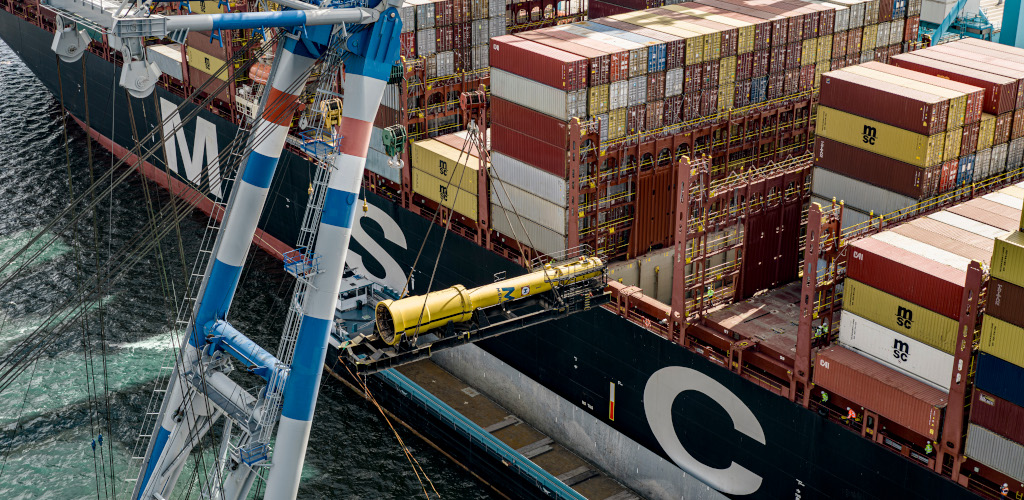
Top photo: MSC uses a container ship a 390-tonne hydraulic hammer from Rotterdam to Singapore. Credit: MSC
Second photo: Ben Collins, MSC. Credit: MSC
Third photo: Leo Liu, Protranser International Logistics. Credit: Liu






.png?ext=.png)








.png?ext=.png)









_1.jpg?ext=.jpg)