
Jani Pekka Tarpio on Solving Increasingly Complex Global Projects
By Simon West
To support the rapidly expanding worldwide energy storage market, UTC Overseas has launched a dedicated global BESS (Battery Energy Storage Systems) group, selecting VP of Global Energy Solutions and Special Projects Jani Pekka Tarpio to lead the new unit. In his first interview since taking on the role, Tarpio discusses the logistics of moving increasingly larger, heavier and more complex systems.
From Issue 3, 2026 of Breakbulk Magazine
(6-minute read)
Q: You’ve been described as an “early pioneer” in BESS logistics. At what point did you know that battery energy storage would become a major global market, and what were the biggest challenges in those early projects?
.jpeg) Jani Pekka Tarpio: The turning point for me was watching storage stop being an add-on to solar projects and start being procured on its own merits. That shift came sharply into focus around 2020 to 2021, as utilities began contracting standalone storage capacity and manufacturers responded by industrializing container production. It was clear this was not a niche. The freight volumes implied by even a modest pipeline of gigawatt-hour projects were enormous.
Jani Pekka Tarpio: The turning point for me was watching storage stop being an add-on to solar projects and start being procured on its own merits. That shift came sharply into focus around 2020 to 2021, as utilities began contracting standalone storage capacity and manufacturers responded by industrializing container production. It was clear this was not a niche. The freight volumes implied by even a modest pipeline of gigawatt-hour projects were enormous.
What made those early projects pioneering was less the batteries than the logistics. The technology itself had existed for years, but BESS freight had never been treated as a discipline in its own right. Carriers had no settled position on how to handle large lithium-ion consignments, terminals varied enormously in what dangerous goods they would accept, and there was very little published guidance on state of charge in transit. We were writing method statements from first principles, project by project and often persuading counterparties to accept a cargo profile they had simply never handled before.
The complexity was compounded by the fact that, in those days, a unit did not always travel as a single finished assembly. On several early projects the shells — the housings for the units — were shipped separately from the battery content. The shells were first planned to move in high-cube containers but were later shipped on flat racks instead. The battery modules, or battery racks, moved in reefer containers, because they required temperature and humidity control that an ordinary box could not provide. That may be history now, but it was a real example of what this work demanded: connecting a great many separate dots — different equipment, different modes, different handling requirements — and making them arrive together as one working system.
Even in those early days, the broader challenges were already revealing themselves. The first-generation BESS units were smaller and could be shipped separately, mainly on flat racks via container vessels and the project sizes at the time made that feasible. But even then, container slot allocations were highly limited and unreliable. For that reason, on one past project, we made the decision to pivot the entire shipping plan from flat racks to a breakbulk vessel — not because the cargo necessarily required it, but to secure guaranteed allocations and, by extension, protect the project schedule. The economics made sense once we accounted for delay risk. That experience taught me early that mode selection is never just about the equipment; it is about controlling the timeline.
Q: Why was now the right time for UTC Overseas to launch a dedicated global BESS unit? What specific capabilities or services will the new unit offer that customers could not access before?
JPT: Storage has matured to the point where ad-hoc handling is no longer good enough. Projects are larger, delivery windows are tighter and the compliance environment around lithium-ion is far more demanding than it was even three years ago. Our clients were asking for a single accountable team rather than a series of local arrangements, and it made sense to formalize what had already become a specialization.
The unit brings together dangerous goods competence, heavy-lift and breakbulk capability and in-country delivery under one commercial structure. Practically, that means a genuine door-to-site offering, with clear accountability for customs, duty and final placement rather than a handover at the port. It also means preservation and storage planning, route surveys and receiving-window management are treated as part of the scope from day one, not as exceptions.
Port handling is another area where the details decide the budget. Our model includes careful planning of pickup rotations and strategic use of temporary storage to keep equipment moving through the port quickly enough to avoid expensive storage and repositioning charges. This is the kind of operational nuance that only comes from having done it repeatedly.
Q: What are the key oversized components involved in a typical BESS project, and what specialized logistics, transport modes and handling expertise are required to move them safely from origin to site?
.jpg) JPT: The battery enclosures themselves dominate the volume. These are typically 20-foot units, but at weights that increasingly exceed 40 tons — well beyond what a standard box of that size implies. Alongside them come power conversion skids, medium-voltage transformers, switchgear, auxiliary transformers and on larger schemes, prefabricated e-houses that are genuinely out-of-gauge.
JPT: The battery enclosures themselves dominate the volume. These are typically 20-foot units, but at weights that increasingly exceed 40 tons — well beyond what a standard box of that size implies. Alongside them come power conversion skids, medium-voltage transformers, switchgear, auxiliary transformers and on larger schemes, prefabricated e-houses that are genuinely out-of-gauge.
The mix of modes reflects that. Enclosures often move in containerized or breakbulk configuration on multipurpose tonnage; transformers and e-houses require flat racks, lowbeds or modular hydraulic trailers and sometimes barge for the inland leg. The expertise that matters most is unglamorous: correct lifting arrangements for units whose center of gravity is not where the frame suggests, dangerous goods documentation that terminals will actually accept and a route survey done early enough to influence the site layout rather than react to it.
It is also worth remembering that components have not always traveled in their final form. In the earlier generation of projects, housings and battery content were sometimes shipped separately, each with its own handling and environmental profile, which was the reason temperature- and humidity-controlled equipment entered the picture at all. As units have consolidated into complete assemblies, that particular complexity has eased, but the underlying lesson has not: every project demands its own mode analysis. The instinct from the early days — flat racks on container vessels — is no longer the automatic answer as projects scale. Sometimes the deciding factor is allocation security or schedule certainty rather than the cargo itself and the right mode is the one that protects the delivery date, not simply the one that fits the weight. That judgement is where experience earns its keep.
Q: In which regions do you expect to see the strongest growth in BESS deployment over the next few years, and how is UTC preparing for that demand?
JPT: Australia was one of the true pioneers of grid-scale storage. It deployed early, with real ambition and pushed the logistics envelope from the start, and it remains among the largest utility-scale battery markets in the world. By sheer volume, China leads globally, followed by North America, with Europe building out quickly as grid-balancing requirements harden. Beyond those, I would point to the Middle East, where individual projects are being tendered at a scale that changes the logistics conversation entirely and to Chile and parts of Southeast Asia.
Our preparation is deliberately structural rather than opportunistic. We are investing in our own presence in the destination markets that matter, because delivered-duty-paid accountability is very difficult to honor through a chain of agents. We are also building depth in dangerous goods and heavy transport capability regionally, so that project teams are not dependent on a single center of expertise operating across incompatible time zones.
A critical part of that preparation is local port intelligence. Cost structures at the quayside, including chassis, storage dwell and container handling, vary sharply from one market to the next and reward active management. We are building that knowledge into how each regional team operates, so that when a client hands us the full chain, the port leg is controlled rather than absorbed as a surprise.
Q: As BESS projects become larger and more complex, what logistical bottlenecks do you foresee in the coming years? Are you seeing manufacturers change the design or packaging of BESS units to make transport easier or safer?
JPT: The bottlenecks I worry about are terminal and port capacity for Class 9 cargo, availability of specialist inland equipment during peak delivery windows and — most persistently — the mismatch between shipping schedules and site readiness. Grid connection delays routinely leave equipment arriving before a site can receive it, which turns storage and preservation into a technical problem rather than a warehousing one.
Manufacturers are responding, though unevenly. The clearest trend is a deliberate return to standard ISO footprints and lifting arrangements, after a period when unit dimensions drifted in ways that made handling awkward. We also see more attention to transport frames, better protection of protruding thermal management and fire suppression components, and a growing willingness to ship at reduced state of charge. Design for transport is finally being treated as a genuine engineering constraint.
That said, what makes this sector fascinating is that the challenges are never uniform. I have encountered projects where the dominant constraint was entirely different — for instance, managing hourly delivery windows on a site where crane availability was booked in 60-minute slots. That level of precision required route planning down to the minute, coordination with local authorities and driver scheduling that left no room for error. It is a reminder that every project brings its own set of obstacles, and the solution has to be engineered for that specific site, that specific schedule and that specific set of equipment. That is exactly the philosophy we bring to every UTC project.
Q: Are there innovations in design or transport equipment that you think will significantly improve BESS logistics over the coming years?
JPT: Three developments look genuinely useful. The first is in-transit monitoring: temperature, shock and state-of-charge telemetry reported continuously rather than inspected on arrival. That changes preservation from a scheduled routine into a condition-based one, and it materially reduces the risk of degradation going unnoticed during long storage periods. In one instance, a temperature excursion was detected during the voyage that would otherwise have gone unnoticed until discharge. The telemetry allowed us to intervene with the vessel operator before any degradation occurred.
The second is purpose-built handling equipment, such as cradles, spreader arrangements and transport frames engineered around the actual weight distribution of a modern enclosure, rather than adapted from general cargo practice. The third is on the planning side: high-quality route surveys using laser scanning, feeding directly into site layout decisions.
None of these are exotic. What makes them significant is that they move risk management upstream, to the point where it is still cheap to make changes. The most expensive problems in BESS logistics are not the ones you anticipate; they are the ones you discover too late. These innovations help you discover them early.
Q: If you could give developers planning their first utility-scale BESS project one piece of logistics advice, what would it be?
JPT: Bring logistics into the conversation at procurement, not after the purchase order is signed. Almost every serious problem we are asked to solve on a first-time project traces back to a commercial decision taken months earlier without transport input: an Incoterm that fragments responsibility across four parties, a delivery schedule built on the manufacturer’s readiness rather than the site’s, or a site layout fixed before anyone checked whether the access road could carry the loads.
The cost of that early conversation is trivial. The cost of discovering, once equipment is on the water, that no one owns the customs clearance or that the final two kilometers require a bridge assessment, is not. Treat logistics as an engineering input to the project, because that is what it is.
A corollary to that: do not assume that because a logistics model worked on one project, it will work on the next. The equipment may be similar, but the port dynamics, the site constraints, the local regulations and the vessel availability will all be different. Every project needs its own logistics plan, designed from the ground up. That is not inefficiency; that is the reality of moving heavy, dangerous, time-sensitive cargo across international borders. The projects that succeed are the ones that accept that reality early.
BESS logistics has come a long way since the early flat-rack days, but the fundamental principle remains: every project is different, and the logistics plan must be engineered to match it. At UTC, we bring the experience to know what questions to ask and the discipline to execute those answers with precision. In the end, success in BESS logistics isn’t about moving boxes; it’s about delivering certainty in a project where the cost of failure can be measured in millions.
On the Breakbulk Live Stage at Breakbulk Americas: The US LNG Buildout – Energy Security and the Next Wave of Projects. Tuesday, Sept. 22, 11:30am - 12:15pm.
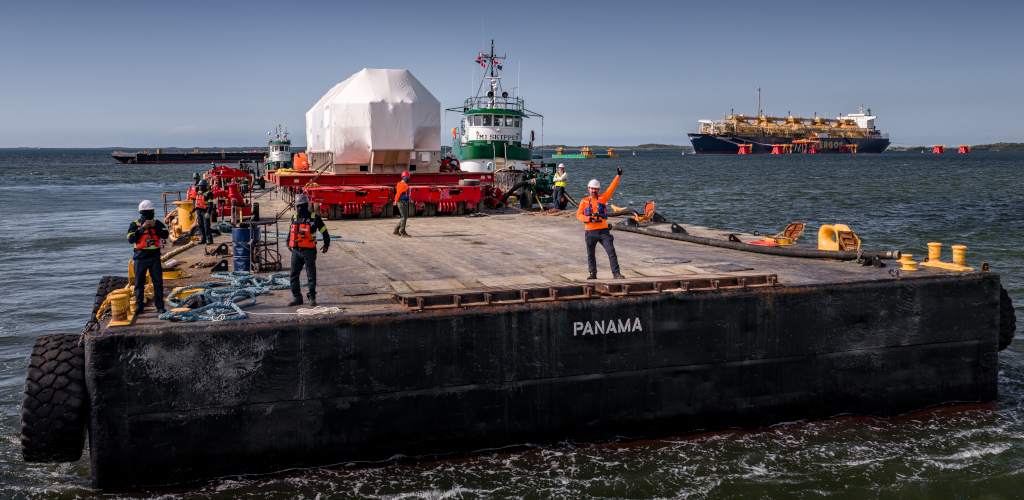
Top photo: UTC Overseas deploys a barge to ship a BESS unit in Central America. Credit: AJ Mrotek - Zero Gravity Productions
Second: Jani Pekka Tarpio. Credit: UTC Overseas
Third: Transporting BESS units requires dangerous goods competence, heavy-lift capability and in-country delivery. Credit: AJ Mrotek - Zero Gravity Productions






.png?ext=.png)








.png?ext=.png)









_1.jpg?ext=.jpg)