Southeast Asian Country’s Industrial Rise Creates Opportunity for Project Cargo
By Iain MacIntyre
Vietnam is moving beyond its reputation as a low-cost manufacturing base. A deliberate, multi-tiered strategy is positioning the country as an increasingly important logistics hub in the region and a growing player in global supply chains.
From Issue 3, 2026 of Breakbulk Magazine
(5-minute read)
Recognized as a low-cost but reputable manufacturing and assembly destination in the late 2000s, Vietnam has more recently pursued a calculated, multi-tiered strategy that is positioning the country as an increasingly important regional logistics hub.
Describing Vietnam as now a “fairly well-established industrial economy,” Aditya Rebbapragada, a partner at Norton Rose Fulbright, said there are a number of factors which have contributed to the country “rapidly moving up the value chain.”
“It is already a major manufacturing platform but still building the energy, logistics, technological and institutional foundations required to become a truly advanced industrial economy,” he said. “A recent example of this is a new regulation aimed at supporting direct purchase of power by industrial parks, manufacturing clusters, data centers and EV charging infrastructure. This is reflective of government policy aimed at supporting the next phase of industrial development rather than simply basic export manufacturing.
“Vietnam has become a key player in global supply chains, particularly in relation to electronics assembly and components, industrial equipment, and now, increasingly, automotive and EV manufacturing. Major global manufacturers such as Samsung, Intel, LG and Foxconn have built substantial production footprints in Vietnam, and multinational companies increasingly see Vietnam as a long-term manufacturing platform.”
According to Rebbapragada, Vietnam benefits from a relatively young workforce, strong educational outcomes for its income level and competitive labor costs. He also highlights the country’s geographic proximity to the Southern China supply chain, its extensive network of free trade agreements and what investors generally regard as a relatively stable operating environment, supported by government policies focused on industrial development.
Creating a Stable Framework
_1.jpg) Considering the country to have now moved beyond the “emerging” phase in this transition, Nick Phung, country manager for Vietnam at logistics provider Dextrans Worldwide, also pointed to the positive influence of government policies to incentivize investors and stabilize the economy.
Considering the country to have now moved beyond the “emerging” phase in this transition, Nick Phung, country manager for Vietnam at logistics provider Dextrans Worldwide, also pointed to the positive influence of government policies to incentivize investors and stabilize the economy.
“Vietnam has been politically stable for many years, has signed multiple FTAs and continues attracting foreign investment,” Phung told Breakbulk. “But the biggest advantage is consistency. Investors generally know what to expect. They can build a factory with the expectation that Vietnam will continue supporting industrial development over the next 10 or 20 years. That confidence matters more than saving a few dollars in labor.”
Phung noted how major development projects are now being launched countrywide.
“Everywhere I travel for projects, I see new industrial parks, expressways, port expansions and energy developments. For project cargo, I don’t think there is only one hotspot anymore. Northern Vietnam continues attracting electronics and manufacturing investment. Central Vietnam has become much more active because of energy and industrial projects. Southern Vietnam remains the country’s logistics center.
“I see renewable energy, liquefied natural gas (LNG), petrochemical, semiconductor and large industrial developments creating the strongest opportunities for heavy-lift and breakbulk logistics over the next decade. More importantly, customers increasingly expect complete logistics solutions, not just ocean freight.”
Multi-year Pipeline
Meanwhile, Rebbapragada anticipates transmission expansion, LNG infrastructure, airport and port development, industrial park growth, and advanced manufacturing investment having potential to generate a “multi-year pipeline of oversized and heavy cargo movements.”
“The infrastructure buildout is concentrated around a number of strategic industrial and logistics corridors,” he said. “In the north, the focus is on the Hanoi-Hai Phong-Quang Ninh corridor, including expansion of the Lach Huyen deep-water port and development of industrial clusters in Bac Ninh, Hai Phong and Quang Ninh. These are emerging as Vietnam’s principal electronics and technology manufacturing hub.
“In the south, investment is centered on the Ho Chi Minh City-Dong Nai-Ba Ria Vung Tau corridor, which includes the Long Thanh International Airport, the Cai Mep-Thi Vai deep-water port complex and extensive industrial park development in Dong Nai, Binh Duong and Ba Ria Vung Tau. Beyond these regional hubs, the North-South Expressway and associated transport links are being developed as a national logistics backbone connecting major cities, industrial zones and ports across the country.”
He sees the concentration of projects along these northern and southern corridors reflect a deliberate effort to build integrated industrial and logistics ecosystems to support Vietnam’s long-term economic growth.
Furthermore, he said, Vietnam is investing in the infrastructure needed for its next phase of industrial development, from transport corridors, deep-water ports and airports to industrial parks, logistics hubs and power networks, as well as digital infrastructure to support high-value manufacturing, data centres and advanced technologies.
“For the breakbulk, project cargo and heavy-lift sectors, these developments point to a substantial and potentially long-duration opportunity,” he said.
“While key challenges remain and need to be addressed, the build-out of transmission infrastructure, LNG facilities, industrial parks, airports, ports and advanced manufacturing facilities is likely to generate sustained demand for the transportation of oversized and heavy cargoes across multiple sectors. Much of this demand is expected to be linked to the construction of the infrastructure and industrial assets supporting Vietnam’s continuing economic development.”
Neither Rebbapragada nor Phung sees Vietnam’s evolution as being driven primarily by recent global unrest or economic and supply chain uncertainty, nor do they expect the country’s progress to be significantly affected if those conditions ease.
“The COVID pandemic, the Red Sea crisis and recent U.S. trade policies certainly accelerated the China Plus One strategy. However, I don’t think Vietnam is simply benefiting from global problems,” Phung said.
“Once a company invests hundreds of millions of dollars into a factory, trains local staff and develops local suppliers, it doesn’t relocate every time the political situation changes. Some projects may slow down, but I don’t expect companies to suddenly leave Vietnam if global tensions ease.”
Rebbapragada believes Vietnam would likely have experienced substantial growth regardless of geopolitical developments, as the underlying drivers were already in place. However, he says an easing of global conflicts and greater stability in trade relationships could moderate the pace of supply chain relocation.
Tackling Potential Stumbling Blocks
.jpg) Rebbapragada is broadly positive about Vietnam’s prospects for continued economic growth and its emergence as an advanced industrial and supply chain hub but acknowledges that significant obstacles remain.
Rebbapragada is broadly positive about Vietnam’s prospects for continued economic growth and its emergence as an advanced industrial and supply chain hub but acknowledges that significant obstacles remain.
He identifies several challenges, including power and grid constraints, as rapid industrial growth risks outpacing electricity generation and transmission capacity, potentially leading to power shortages and grid bottlenecks.
Infrastructure execution is another concern, with delays in land acquisition, permitting, financing, procurement and construction potentially slowing the delivery of major projects. Vietnam also faces a shortage of engineers, technical specialists and experienced managers, while port congestion, transport constraints and uneven infrastructure quality can continue to affect supply chain efficiency.
At the same time, the country faces growing competition for manufacturing investment from India, Indonesia, Malaysia and Thailand, while regulatory and administrative hurdles, including permitting, land approvals and regulatory complexity, can create uncertainty and delays for investors.
“Out of those, the three most important key issues would be power infrastructure, talent development and project execution. If Vietnam is able to effectively address these challenges, it would have the potential to strengthen its role as one of Asia’s leading industrial, logistics and technology platforms.”
Phung agrees that while manufacturing capability has “improved very quickly” in recent times, the required logistics infrastructure, supporting industries and technical services are “still catching up.”
“Execution is still inconsistent. For oversized cargo, we still spend considerable time dealing with route surveys, bridge limitations, transport permits and coordination between different authorities,” he said. “The second issue is people. Vietnam has plenty of young talent, but experienced project logistics specialists are still relatively scarce. Heavy-lift engineering, project planning and risk management require years of experience, and demand is growing faster than the available workforce.”
Vietnam also needs to develop a stronger domestic maritime ecosystem instead of relying heavily on foreign shipping lines and international logistics providers for many high-value services. The next phase of growth, he said, won’t come from adding more factories alone; rather it will depend on how efficiently Vietnam can move cargo, develop ports, improve customs processes and support increasingly sophisticated industries.
“So while the direction is absolutely correct, I think the biggest improvements for logistics companies will appear gradually over the next five to ten years rather than immediately.”
Seizing the Opportunity
Phung reiterates that Vietnam’s biggest opportunity lies in fully establishing itself as a regional logistics and industrial hub rather than being seen as “simply another manufacturing country.”
“Whether that happens depends less on how many factories are built and more on whether the entire ecosystem — ports, transport infrastructure, engineering capability, logistics services and skilled people — can develop at the same pace,” he said. “If that happens, I believe Vietnam’s role in project cargo and breakbulk logistics will become much more significant over the next decade.”
Rebbapragada adds that future growth is likely to depend in part on Vietnam’s increased participation in more sophisticated electronics manufacturing, citing semiconductors as one example.
“Growth in AI digital services and data center development may also create infrastructure investment opportunities,” he said. “To support these key engines of growth, Vietnam would need substantial investments in development of power generation assets as well as ports, warehouses, industrial parks and logistics corridors.”
Breakbulk Asia 2026 is happening on Nov. 18-19 at Marina Bay Sands, Singapore
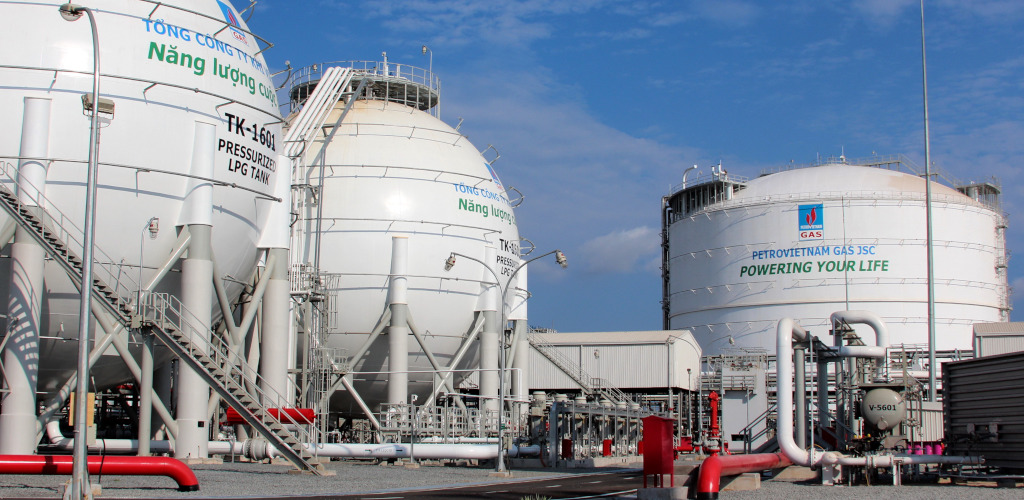
TOP PHOTO: PetroVietnam-owned gas facilities at the Thi Vai Terminal in Ba Ria-Vung Tau Province. Credit: PetroVietnam
SECOND: Nick Phung, Dextrans Worldwide
THIRD: Aditya Rebbapragada, Norton Rose Fulbright



.png?ext=.png)







.png?ext=.png)






_1.jpg?ext=.jpg)