Surge in Project Cargo Demand as NCIC’s Vast Complex Nears Completion
By Malcolm Ramsay
Egyptian heavy-lift specialist EWA recounts the challenge of delivering a 500-tonne ammonia reactor by road for NCIC’s mammoth fertilizer project at Ain Sokhna on the Gulf of Suez.
From Issue 1, 2026 of Breakbulk Magazine
(5-minute read)
Development of the El Nasr Company for Intermediate Chemicals (NCIC) fertilizer complex in Egypt has driven a wave of project cargo activity in recent months, as construction of new infrastructure approaches completion. Focused on reducing the country’s dependence on fertilizer imports, the NCIC complex in Ain Sokhna, on the Gulf of Suez, is projected to be the biggest fertilizer complex in North Africa once completed.
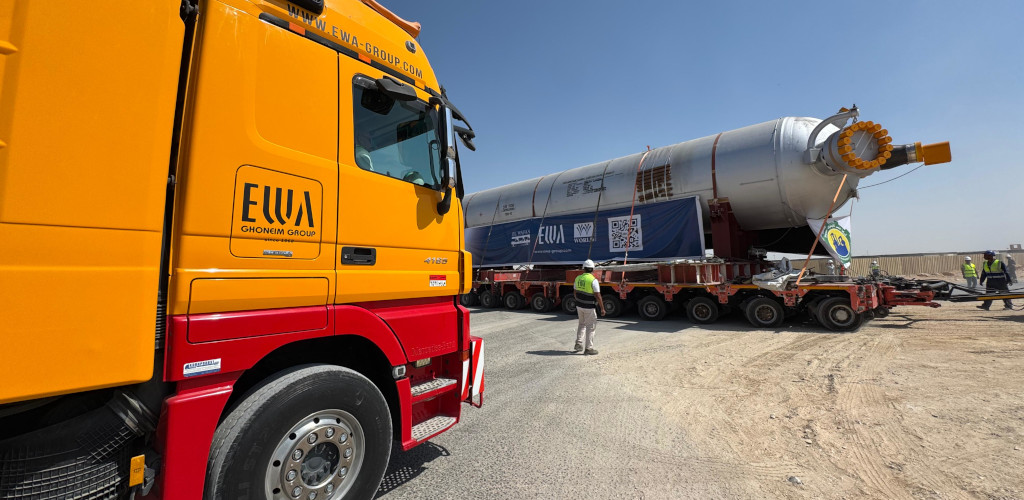
To achieve this ambitious goal, construction has required a series of significant breakbulk moves, with numerous outsized cargoes arriving on site for installation. Among the largest of these was the recent delivery of a giant ammonia reactor, tipping the scales at over 500 tonnes. This colossal component was transported by road from the nearby DP World Sokhna Port, a journey overseen by Egyptian heavy-lift logistics specialist El Wafaa Transport and World Trans Group, a subsidiary of EWA Group.
“EWA secured this project thanks to our extensive experience and strong market presence in the oil and gas sector, particularly in complex project logistics,” Adham Ghoneim, business development manager at EWA, told Breakbulk, noting that “the client’s requirements went far beyond standard transport operations.
“They sought a partner capable of providing end-to-end logistics solutions, coordinating with government authorities and the Ministry of Transport, and executing the transport operations with precision and compliance.”
The challenge posed by this comprehensive brief was magnified by the reactor’s enormous size and weight, coupled with the sensitive, high-tech nature of its internal components. Designed to sit at the heart of NCIC’s ammonia production facility, the reactor was manufactured in Japan and transferred to a port on the southern Japanese island of Kyushu.
“It was vital to develop a comprehensive HSE (Health, Safety, and Environment) plan to ensure safe and efficient execution at every stage,” Ghoneim notes, emphasizing the extensive planning and route surveying from the outset in order to map out the entire journey.
“We had to ensure that the route could handle not just the weight, but the dynamic forces exerted by a moving load of this magnitude,” Ghoneim adds. “This included assessing bridge load limits, road geometry and even the impact of wind and weather on the convoy.”
The firm’s technical office used tools such as BricsCAD and AutoCAD to simulate the route digitally, allowing the team to identify obstacles well in advance and avoid scheduling issues. With this data in hand, they were able to begin planning civil works. As Ghoneim notes: “Our ability to combine strategic planning, regulatory coordination and operational excellence was key to successfully meeting the client’s expectations and securing the project.”
Headquartered in Bab Sharq, Alexandria, EWA provides heavy-lift logistics across Egypt and the broader MENA region. The company’s specialized fleet includes modular trailers, hydraulic axles and heavy-duty cranes, and the team has a range of experience handling breakbulk cargoes. This has included working on projects from construction of nuclear power plants and petrochemical complexes to deep bore tunnels and Olympic stadiums.
Discharge at Sokhna
At the port of Moji in Japan, the reactor was loaded aboard the Paderewski, a general cargo vessel operated by Chipolbrok featuring adjustable tweendecks and box-shaped holds, providing flexible cargo stowage options. These provide unobstructed deck space of 120 x 20 meters, helping accommodate outsized loads such as the reactor unit. The ship is also equipped with three heavy-lift cranes, each capable of lifting 45 tonnes at a 36-meter reach, allowing the crew to handle loads up to 700 tonnes at an 11-meter reach, when used in tandem.
“The giant ammonia reactor completed its 9,000-mile voyage from Japan aboard the Paderewski, marking a milestone in our collaboration with EWA Group,” said Mahmoud Atta, commercial manager for bulk cargo at DP World Sokhna. “From the moment it arrived at our port, our team worked hand-in-hand with EWA to execute a flawless discharge operation, ensuring the reactor’s safe and efficient transfer.”
At dock the reactor was loaded directly onto Faymonville self-propelled modular transporters (SPMTs) using the Paderewski on-deck cranes, ready for the onward journey by road. This discharge process took three hours and saw the unit transferred to SPMT with 24 axles in side-by-side configuration.
From the moment the unit arrived in Egypt, close communication between EWA, NCIC, DP World and the Egyptian authorities was vital. Atta explains: “There was 24/7 communication between all the partners from before the cargo arrived on shore. This ensured everything was fully coordinated, from the removal of obstacles in port to the completion of civil works inside the site.”
Bridge Building
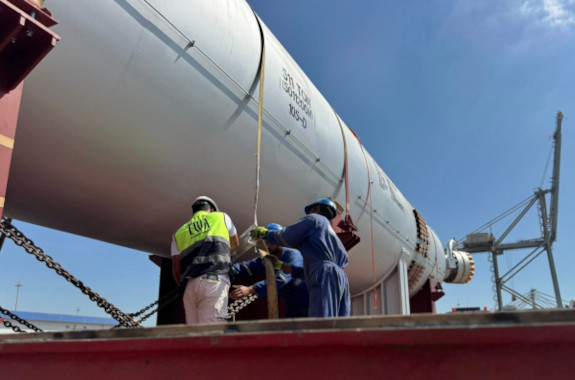 With the reactor secured, EWA’s team then faced the next critical challenge: moving the 511-tonne colossus through the port and out through the neighboring streets. Thanks to their detailed route surveys, the project team had already identified several critical pressure points, particularly around bridges and narrow road sections, where the reactor’s 8.5-meter diameter posed significant challenges. To mitigate these risks, they developed a reinforcement plan, involving the construction of temporary bridge supports, road strengthening and obstacle removal.
One of the most daunting civil engineering feats was the creation of a bypass over an active railway. Ghoneim recalls: “We had to negotiate for a long time with the Ministry of Transport to halt train operations and even then we were only able to stop the trains for four hours. In that window, we had to fill the rail bed, create a solid, compact surface for the trailer to pass, then restore everything to its original state.”
This operation required military-level precision, as any delay or miscalculation could have disrupted national rail services and jeopardized the project’s timeline. Although the route to the plant was only around 20 kilometers, there was significant work required along the path to ensure that the load could pass safely. EWA’s civil works team reinforced road sections, removed overhead obstacles and constructed temporary bypasses to accommodate the reactor’s dimensions.
To complete these works efficiently, the team liaised closely with Egyptian authorities as well as engineering consultants from NOSCO Egypt to develop reinforcement strategies for these critical sections of the route. In many cases this meant ensuring that their adjustments or additions were completely reversible, so as to avoid leaving any lasting impact on public infrastructure or the environment.
EWA deployed prime movers from Mercedes-Benz and MAN, offering the torque and stability needed to move the NCIC reactor. The Mercedes-Benz Actros and MAN TGS models deployed both feature advanced drivetrain technology making them ideal for this sort of heavy-haul operation.
Equipped with a 12.8-liter inline-6 engine, the Actros delivered up to 625 horsepower and 3,000 Nm of torque. Complementing the Actros was a MAN TGS, featuring a 15.2-liter engine, producing up to 640 horsepower and 3,000 Nm of torque. Both vehicles were supplied by local logistics partner NOSCO.
Hydraulic Precision
Upon arrival at the NCIC complex, the reactor’s final placement was executed with meticulous care. EWA’s team utilized hydraulic jacking and skidding systems, supported by stools and beams, to manually lower the reactor into position. This method ensured controlled, millimeter-perfect alignment, avoiding the need for cranes and minimizing the risk of damage to the reactor’s delicate internal components.
“The unloading process was conducted manually using hydraulic systems on stools and beams,” Ghoneim explained. “This approach allowed us to maintain complete control over the reactor’s movement, ensuring it was positioned with the precision required for such a critical piece of industrial infrastructure.”
Following the successful transport and installation of the ammonia reactor, the NCIC fertilizer complex in Ain Sokhna is now nearing completion, with over 90% of the development already finished. The reactor, a cornerstone of the complex’s ammonia production, will support the site in producing 1,200 metric tonnes of ammonia per day, alongside 380,000 tonnes of urea and 300,000 tonnes of calcium ammonium nitrate (CAN) annually.
Remaining work is now focused on commissioning, testing and startup procedures. This includes finalizing the integration of KBR’s Purifier ammonia technology, completing the urea melt and granulation plant and testing auxiliary systems, including the seawater desalination plant and storage facilities for calcareous-nitrate fertilizers.
Once fully operational, it is planned that the NCIC complex will dramatically reduce Egypt’s reliance on imported fertilizers, saving billions in foreign exchange and stabilizing agricultural supply chains, as well as helping to transform Egypt’s long-term economy. With an estimated US$33 billion in investments for green hydrogen and ammonia projects, the new facilities aim to provide a bedrock for the emerging green energy economy in the region.
“This project is more than a logistical triumph — it is a symbol of what Egypt can achieve when vision, expertise and collaboration converge,” Ghoneim concludes. “As it moves into the final phases of commissioning and startup, we are proud to have played a role in a project that will secure Egypt’s agricultural future and position the country as a leader in the global fertilizer market.”
Read more: Egyptian Logistics Boom

.png?ext=.png)


.png?ext=.png)



_1.jpg?ext=.jpg)