Coal, Gas and the Gravitational Pull of the Status Quo
In this three-part feature, Ben Carrozzi, partner at Norton Rose Fulbright, examines the energy choices facing governments across the region. In the first instalment, he explores why coal and gas remain entrenched as default transition fuels in resource-rich countries.
From Issue 4, 2026 of Breakbulk Magazine.
(3-minute read)

Until recently, some 20% of global liquefied natural gas (LNG) and a quarter of seaborne oil transited the Strait of Hormuz. Qatar alone has typically supplied about a fifth of global LNG, meaning any sustained disruption translates directly into higher power generation costs across Asia-Pacific, a region where gas-fired power generation underpins electricity systems from Singapore to South Korea.
While the immediate impacts of the Middle East disruption are now well documented, the more consequential question is whether this is a temporary shock or the beginning of a more unstable, “higher-for-longer” global energy environment. The answer will depend on whether governments treat this disruption as a genuine inflection point for energy policy across APAC, or whether it will ultimately be absorbed as another shock leaving the region’s structural energy dependencies intact.
Bound up in this question is a harder one: what does a pragmatic approach toward decarbonization actually look like in a region where net-zero commitments, economic development, energy access and security can sometimes pull in competing directions? The policy responses that emerge will need to strike a delicate balance and, in some cases, may diverge from prevailing assumptions about what counts as an acceptable pathway toward a cleaner and more secure energy future.
Three Competing Strategic Responses
In seeking to chart a path beyond the current crisis, governments in the region face three broad, yet interrelated, strategic policy options.
The first is to double down on traditional fuel dependencies — coal in resource-rich nations, expanded LNG infrastructure elsewhere. The second is to accelerate investment in conventional renewables — solar, wind and battery storage — on the basis that domestically generated green electrons are inherently more secure than imported molecules. The third and most difficult is to make the more expensive, long-term decarbonization bets — green molecules, carbon capture and storage (CCS) and nuclear — in the interests of lasting energy security. Whether current events shift the equilibrium meaningfully toward longer-term investments remains an open question.
Doubling Down
The risk of reversion is most acute in countries that are resource-rich and structurally tied to legacy thermal power generating fleets. Over the course of the crisis, we have seen Indonesia reduce coal exports in order to protect its domestic power prices. Similarly, Pakistan increased coal dispatch in response to LNG supply curtailments.
Of particular interest is whether this constitutes a rational, time-limited fallback or whether it entrenches coal dependence for a further generation. And, indeed, whether the binary framing of this policy choice is itself unhelpful.
Coal and Clean Coal Technologies
In Indonesia, super-critical and ultra-super-critical plants, coal gasification technologies that produce syngas-derived products (including hydrogen, ammonia, methanol, dimethyl ether (DME) and other synthetic fuels that can be decarbonized by pairing them with CCS) and coal-to-liquid (CTL) processes are all under active consideration.
Indonesia’s sovereign wealth fund Danantara continues to back the revival of the country’s coal-to-DME program as part of the government’s broader downstream energy strategy. A groundbreaking ceremony initially planned for February 2026 was postponed pending further assessment of technology selection and commercial viability.
In July, Danantara entered into a memorandum of understanding with Latitude Energy Holdings to explore a large-scale coal-gasification platform. The program remains strategically attractive as a means of reducing Indonesia’s heavy dependence on imported liquefied petroleum gas (LPG), although its economics, emissions profile and financing prospects remain uncertain.
CTL technologies hold a broader attraction for Indonesia, which has a significant number of constructed but not-grid-connected coal-fired power plants; however, the economics and emissions profile continue to raise significant concerns.
These concerns are further compounded by an increasingly restrictive investment and financing landscape, undermining this pathway’s long-term viability and access to capital. Multilateral and development finance institutions have adopted entrenched positions against any coal-related financing, and commercial banks have followed suit under similar ESG commitments. This position appears unlikely to change in the near term despite the apparent merits and emerging energy transition narrative surrounding some of these technologies.
Gas and LNG: The Bridge that Keeps Extending
Gas nevertheless remains difficult to displace from the regional energy mix. As electricity demand grows and variable renewable capacity expands, dispatchable generation will continue to play an important role in maintaining system reliability. The policy question is therefore not simply whether Asia-Pacific should use more or less gas, but whether its gas strategy is sufficiently diversified, flexible and resilient to withstand a structurally more volatile market.
Paradoxically, current events have also accelerated LNG infrastructure development in the region — albeit with a sharpened focus on supply diversification. Critically, recent disruptions have also refocused attention on Australian LNG, which despite its higher cost base, offers shorter and more predictable shipping routes to South and Southeast Asia.
Yet Australia’s capacity to serve as a regional supply buffer is constrained. LNG exports account for approximately 83% of Australia’s gas production, leaving domestic consumers exposed to tight supply and elevated prices. The Australian government has responded by conducting quarterly domestic-supply assessments under the Australian Domestic Gas Security Mechanism, which permits LNG export controls where a shortfall is forecast. Production from existing projects is already mostly contracted, and new projects face high costs and stringent emissions obligations under the Safeguard Mechanism.
The net effect is that Australia’s role as an LNG supplier to Asia is becoming as much a domestic political question as a commercial one.
Supply resilience is not solely a question of replacing one source of LNG with another. It also depends on portfolio diversification, contractual flexibility, access to shipping and regasification capacity, and an appropriate balance between long-term contracted supply and spot-market exposure.
Vietnam presents a nuanced example of the inherent tension between energy security ambitions and the need for regulatory reform. Its National Power Development Plan targets 22.4 gigawatts (GW) of LNG power by 2030, but S&P Global expects only 6 to 7 GW to materialize.
The obstacle is bankability. Vietnam’s Decree 56 (March 2025) sets a minimum contracted electricity output of 65% for LNG-to-power projects, capped at 10 years — well short of the 15- to 20-year guarantees foreign developers and lenders require. A draft amendment proposed in January 2026 seeks to raise the offtake guarantee to 75% and extend the tenor to 15 years; however, uncertainty persists regarding payment security, dispatch, curtailment and LNG fuel-alignment risks.
Geothermal: The Domestic Baseload Alternative
Indonesia has one of the world’s largest geothermal resources, with estimated potential exceeding 23 GW, and the world’s second-largest installed capacity at about 2.7 GW. The government has set a target of over 7 GW of geothermal power capacity in its updated 2025- 2034 roadmap, and the sovereign wealth fund Danantara has allocated US$120 million for 19 geothermal projects. The Asian Development Bank signed a US$92.6 million financing agreement in January 2025 to develop geothermal resources in West Sumatra.
Yet projects remain affected by delays, high exploration risk and community opposition. Singapore is also exploring geothermal as part of its diversification strategy, though its geological characteristics are less favorable. The energy security case is compelling — domestic, baseload-capable, weather-independent — but unlocking it at scale demands sustained regulatory reform.
Read more in the series:
Renewables and Green Molecules: The Harder, Longer Bet
AI, Nuclear and the Case for Regional Collaboration
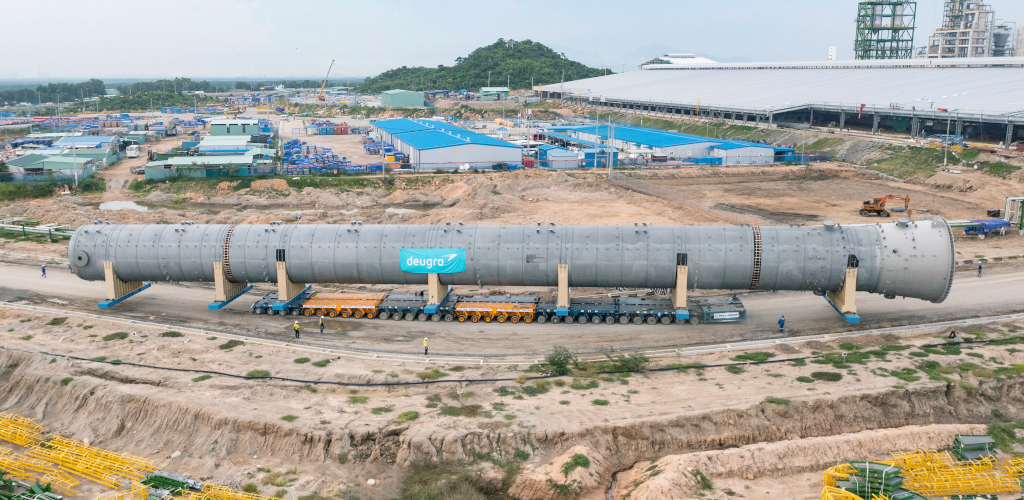
Top photo: deugro transports a massive 800-metric-ton C3 tower column over a 6-km route from Gebeng in Malaysia to Kuantan Port. Credit: deugro